

Introduction
Investors often categorize stocks into two broad investment styles—value stocks and growth stocks. While value stocks are generally considered undervalued relative to their fundamentals, growth stocks are companies expected to deliver faster revenue and earnings expansion in the future.
Understanding the distinction between these categories can help investors evaluate businesses more effectively and align investment decisions with their financial goals and risk tolerance.
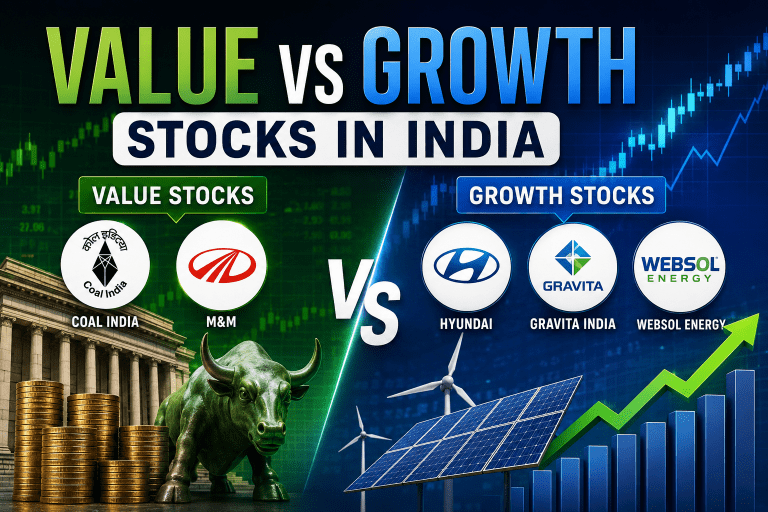
Recent market discussions have highlighted companies such as Coal India, Mahindra & Mahindra (M&M), Hyundai Motor India, Gravita India and Websol Energy as examples of businesses that exhibit characteristics associated with value or growth investing. However, it is important to note that classifications may evolve over time as company fundamentals and market conditions change.
This article explains the difference between value and growth investing, examines the characteristics of these companies and highlights key factors investors should consider while evaluating stocks.
Key Highlights
- Value stocks typically trade at relatively lower valuations compared to their fundamentals.
- Growth stocks are expected to deliver higher-than-average revenue and earnings growth.
- Coal India is often viewed as a value-oriented stock due to its mature business profile and dividend track record.
- Companies such as Gravita India and Websol Energy are frequently associated with growth opportunities.
- Mahindra & Mahindra and Hyundai Motor India display characteristics of both value and growth investing.
- Investors should evaluate business fundamentals rather than relying solely on stock classifications.
What Are Value Stocks?
Value stocks are companies that trade at valuations perceived to be lower relative to their earnings, book value, cash flows or intrinsic worth.
These companies often belong to mature industries and may generate stable cash flows despite experiencing slower growth compared to emerging businesses.
Common Characteristics of Value Stocks
Lower Valuation Multiples
Value stocks often trade at relatively lower:
- Price-to-Earnings (P/E) ratios
- Price-to-Book (P/B) ratios
- Enterprise Value multiples
Established Business Models
Most value companies operate businesses with established market positions and predictable revenue streams.
Dividend Income
Many value stocks distribute a portion of profits to shareholders through dividends.
Lower Growth Expectations
The market may expect moderate rather than rapid future earnings growth.
What Are Growth Stocks?
Growth stocks are companies expected to grow revenue, profits or market share at a faster pace than the broader market.
Investors typically focus on future expansion opportunities rather than current valuation metrics.
Common Characteristics of Growth Stocks
Rapid Revenue Growth
Growth companies often report strong sales expansion.
Expanding Market Opportunity
These businesses frequently operate in sectors benefiting from structural growth trends.
Reinvestment Focus
Profits are often reinvested into expansion initiatives rather than distributed as dividends.
Higher Valuations
Growth stocks may trade at premium valuations due to future growth expectations.
Value Stocks vs Growth Stocks: Key Differences
| Factor | Value Stocks | Growth Stocks |
|---|---|---|
| Valuation | Generally Lower | Often Higher |
| Revenue Growth | Moderate | Faster |
| Dividend Yield | Usually Higher | Usually Lower |
| Risk Level | Relatively Lower | Relatively Higher |
| Market Expectations | Conservative | Optimistic |
| Investor Objective | Stability & Income | Capital Appreciation |
Why Is Coal India Often Considered a Value Stock?
Coal India is frequently cited as a value-oriented stock due to several characteristics commonly associated with value investing.
Mature Business Model
Coal India operates in an established industry with significant market presence.
The company’s business model is supported by long-term demand from power generation and industrial sectors.
Strong Cash Flow Generation
Stable operational cash flows have historically supported business sustainability and capital allocation flexibility.
Dividend Track Record
Many investors track Coal India for its dividend distribution history, a feature often associated with value investing.
Attractive Valuation Metrics
Value investors frequently analyze valuation indicators such as earnings multiples, cash flow generation and dividend yield when evaluating mature businesses.
Why Is Mahindra & Mahindra Viewed as a Growth-Oriented Opportunity?
Mahindra & Mahindra combines characteristics of both value and growth investing.
Leadership in Utility Vehicles
The company continues to strengthen its presence in the SUV market through new product launches and market share gains.
Expansion in Electric Mobility
The automotive industry is undergoing significant transformation due to electrification.
Mahindra’s investments in electric vehicles have attracted attention from investors seeking long-term growth opportunities.
Rural and Agricultural Exposure
Its diversified presence across tractors, farm equipment and automobiles provides multiple growth drivers.
Where Does Hyundai Motor India Fit?
Hyundai Motor India represents another interesting example of a company that may display both value and growth characteristics.
Strong Brand Recognition
The company has established a strong position within the Indian passenger vehicle market.
Product Portfolio Expansion
Continuous product innovation and new vehicle launches contribute to future growth opportunities.
Growing Premium Vehicle Segment
Increasing consumer demand for premium vehicles may support long-term business expansion.
Why Gravita India Is Often Viewed as a Growth Stock
Gravita India operates in the recycling and resource recovery industry, a segment benefiting from sustainability and circular economy trends.
Expanding Recycling Capacity
The company continues to invest in capacity expansion and operational growth.
Global Demand for Recycled Materials
Environmental regulations and sustainability initiatives have increased demand for recycled resources.
International Business Presence
Diversified geographic operations provide exposure to multiple markets and growth opportunities.
What Makes Websol Energy a High-Growth Renewable Energy Stock?
Websol Energy System has gained investor attention amid growing interest in renewable energy and domestic solar manufacturing.
Solar Manufacturing Opportunity
India’s renewable energy transition has created opportunities for solar component manufacturers.
Government Support for Renewable Energy
Policy initiatives aimed at increasing domestic solar production continue to shape industry growth prospects.
Capacity Expansion Plans
Investors often monitor manufacturing capacity additions as a potential indicator of future revenue growth.
Can a Stock Be Both a Value and Growth Stock?
Yes.
Many successful companies demonstrate characteristics of both categories.
Examples include businesses that:
- Generate strong cash flows
- Trade at reasonable valuations
- Continue expanding revenue and profits
- Operate in growing industries
As a result, stock classifications may evolve over time depending on business performance and market expectations.
What Factors Should Investors Evaluate?
Regardless of whether a company is classified as a value or growth stock, investors often analyze the following factors.
Revenue Growth
Consistent revenue expansion may indicate increasing business demand.
Earnings Growth
Profitability trends provide insights into operational performance.
Valuation Metrics
Common valuation measures include:
- Price-to-Earnings Ratio (P/E)
- Price-to-Book Ratio (P/B)
- EV/EBITDA
- Free Cash Flow Yield
Competitive Position
Companies with sustainable competitive advantages may be better positioned for long-term growth.
Debt Levels
Financial stability remains an important consideration across all sectors.
Risks Investors Should Consider
While both value and growth stocks offer opportunities, each category carries unique risks.
Risks in Value Stocks
- Business stagnation
- Industry disruption
- Slower earnings growth
- Regulatory challenges
Risks in Growth Stocks
- Premium valuations
- Execution risks
- Slower-than-expected expansion
- Increased competition
Frequently Asked Questions (FAQs)
What is the difference between value and growth stocks?
Value stocks generally trade at lower valuations relative to fundamentals, while growth stocks are expected to deliver faster future expansion in revenue and earnings.
Is Coal India a value stock?
Coal India is often viewed as a value-oriented company due to its established business model, cash generation and dividend profile.
Why is Websol Energy considered a growth stock?
The company operates within the renewable energy sector, which benefits from long-term growth opportunities and increasing solar adoption.
Can Mahindra & Mahindra be both a value and growth stock?
Many investors believe M&M displays characteristics of both categories due to its established operations and future growth initiatives.
Which is better: value investing or growth investing?
Neither approach is inherently superior. Suitability depends on an investor’s objectives, investment horizon and risk tolerance.
Conclusion
Value and growth investing represent two widely followed approaches to stock selection. Companies such as Coal India, Mahindra & Mahindra, Hyundai Motor India, Gravita India and Websol Energy illustrate how businesses can exhibit different characteristics depending on their industry position, growth prospects and valuation profile.
Rather than focusing solely on labels, investors may benefit from evaluating business fundamentals, financial performance, competitive advantages and long-term growth opportunities. Understanding how value and growth characteristics influence investment decisions can help build a more informed approach to analyzing stocks and market opportunities.
Disclaimer
This article is intended solely for educational and informational purposes. It should not be construed as investment advice, stock recommendations, research reports or an invitation to buy or sell securities. Investors should conduct their own research and consult a SEBI-registered investment adviser before making investment decisions. Investments in securities markets are subject to market risks. Read all related documents carefully before investing.