Introduction
Every earnings season triggers the same question:
“Which banking stock should I invest in now?”
But reacting directly to quarterly results is often where investors go wrong.
Short-term numbers create noise, while long-term wealth is built by understanding business quality, risk, and consistency.
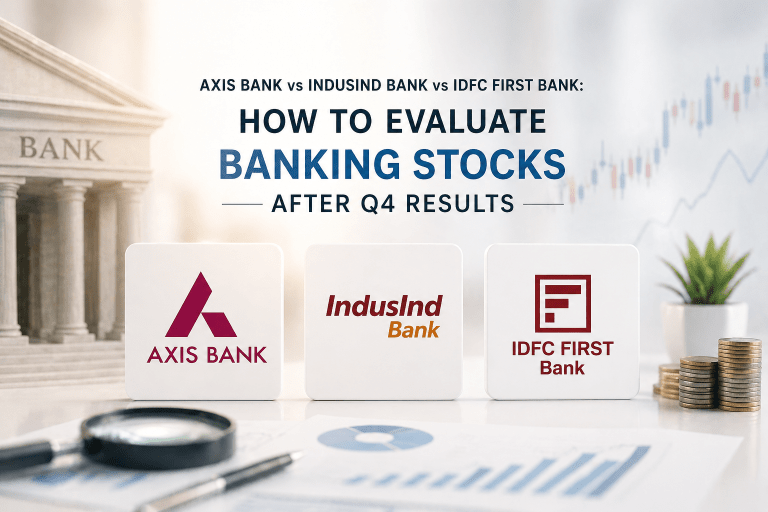
In this blog, we break down how to evaluate banking stocks like Axis Bank, IndusInd Bank, and IDFC First Bank after results—without relying on speculation or short-term triggers.
Why You Should Not Rely Only on Q4 Results
Quarterly results provide a snapshot, not the full picture.
A single quarter can be influenced by:
- Temporary changes in provisioning
- Interest rate cycles
- One-off events
- Sector-wide trends
👉 That’s why smart investors focus on structural indicators, not just recent performance.
3 Key Factors to Evaluate Banking Stocks
Instead of asking “which stock is best,” ask:
1. Business Stability vs Growth Potential
Some banks focus on consistency and scale, while others prioritize expansion and market capture.
- Established banks often offer predictability
- Emerging banks may offer higher growth potential, but with variability
Ask yourself:
Do you prefer stability or growth?
2. Asset Quality and Risk Management
A bank’s long-term performance depends heavily on how well it manages risk.
Key considerations:
- Quality of loan book
- Exposure to risky segments
- Consistency in handling credit cycles
👉 Strong risk management often matters more than short-term growth.
3. Management Strategy and Execution
Banking is a management-driven business.
Look for:
- Clear long-term strategy
- Consistency in execution
- Transparency in communication
📌 Over time, markets reward predictable and disciplined leadership.
Different Types of Banking Stories Investors Should Understand
When comparing banks, they typically fall into three broad categories:
Established Players
- Focus: Stability and consistent operations
- Suitable for: Investors seeking relatively lower volatility
Turnaround Cases
- Focus: Recovery from past challenges
- Suitable for: Investors comfortable with higher uncertainty
Growth-Focused Banks
- Focus: Expansion and future potential
- Suitable for: Long-term investors willing to wait for scale
How to Choose the Right Banking Stock for You
There is no “one-size-fits-all” answer.
Your decision should depend on:
- Your risk appetite
- Your investment horizon
- Your portfolio diversification strategy
Instead of chasing the “top performer,” align your choice with your financial goals.
Common Mistakes to Avoid
❌ Investing based only on recent results
❌ Following market noise or social media trends
❌ Ignoring risk factors
❌ Expecting quick returns from fundamentally long-term businesses
A Smarter Approach to Bank Investing
A more disciplined approach includes:
✔ Evaluating long-term business quality
✔ Tracking consistency over multiple quarters
✔ Avoiding emotional decisions
✔ Staying aligned with your investment strategy
Conclusion
Quarterly results can create excitement—but they should not dictate your investment decisions.
The real edge lies in:
- Understanding business models
- Evaluating risk
- Staying patient
In the long run, disciplined investing beats reactive investing.
Disclaimer
This content is for educational purposes only and should not be construed as investment advice or a recommendation to buy or sell any securities. Investors should conduct their own research or consult a financial advisor before making any investment decisions.