When crude oil prices rise sharply, markets don’t react randomly — they reprice earnings expectations across sectors.
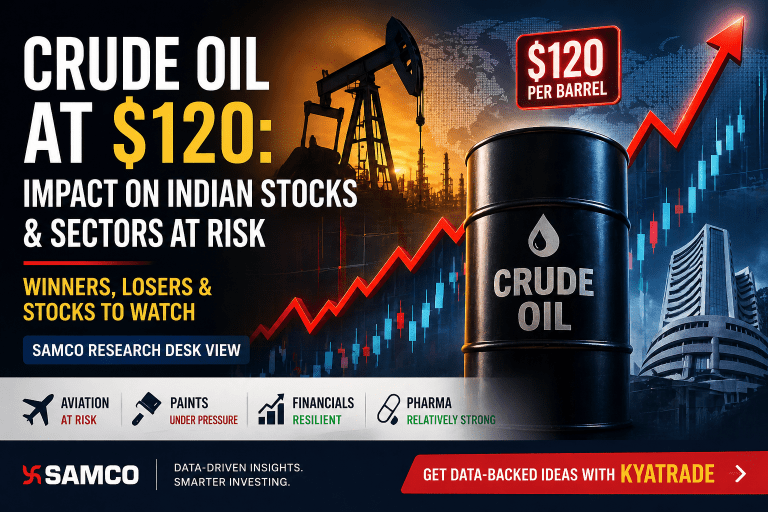
Recent estimates suggest that if crude sustains near $120, India’s corporate earnings growth could slow from ~16% to ~11%. That’s not just a statistic — it’s a structural shift in profitability assumptions.
From the lens of the Samco Research Desk, this phase is less about panic and more about understanding sectoral impact and capital flow shifts.
Why Crude Oil Is a Critical Market Variable

India is a net importer of crude oil, which makes the economy sensitive to price spikes.
A sustained rise in crude typically leads to:
- Higher inflation
- Increased input costs for companies
- Pressure on consumption demand
- Currency depreciation risks
From a market standpoint, this translates into earnings compression, especially in cost-sensitive sectors.
Earnings Impact: What Changes When Oil Hits $120?
At elevated crude prices:
- Operating margins shrink in raw material-heavy industries
- Consumer demand slows due to inflationary pressure
- Companies struggle to pass on costs immediately
- Earnings growth estimates get revised downward
👉 This is why markets adjust valuations — not because growth disappears, but because cost structures change faster than revenues.
Sectoral Impact of Rising Crude Oil Prices
Sectors Under Pressure
Aviation: Direct Exposure to Fuel Costs

Fuel is one of the largest expenses for airlines.
Impact:
- Sharp rise in operating costs
- Pressure on margins
- Demand sensitivity due to higher ticket prices
👉 High sensitivity makes this segment vulnerable during oil spikes
Paint Companies: Raw Material Dependency

Paint companies rely heavily on crude-linked derivatives.
Impact:
- Input cost inflation
- Short-term margin pressure
- Limited immediate price pass-through
👉 Strong linkage with crude makes profitability cyclical
Auto Sector: Indirect Demand Pressure
- Higher fuel costs reduce discretionary spending
- Input cost inflation impacts margins
- Demand cycles become weaker
Sectors That Show Relative Resilience
Financials
- Limited direct exposure to crude
- Driven more by credit growth cycles
Pharmaceuticals
- Export-oriented demand
- Lower dependency on crude-linked inputs
Select Oil Producers
- Upstream companies may benefit from higher crude
- However, regulatory factors can influence profitability
Samco Research Desk View: Follow Earnings, Not Headlines
Crude oil spikes don’t impact all stocks equally.
Markets typically respond by:
- Rotating capital away from cost-sensitive sectors
- Rewarding businesses with pricing power
- Favouring companies with stable margins
👉 The real signal lies in earnings resilience, not short-term price movement
Framework: How to Identify Stocks in High Oil Price Environments
Instead of searching for direct “buy” ideas, focus on characteristics:
- Low dependence on crude-based inputs
- Ability to pass on rising costs
- Stable operating margins across cycles
- Strong balance sheet and cash flows
👉 This aligns with search intent: stocks to buy when crude oil rises India
What This Means for Market Participants
This is a macro-driven phase, where:
- Commodity prices influence market direction
- Sector selection matters more than index movement
- Volatility increases due to global uncertainty
Understanding sectoral impact becomes more important than reacting to daily news.
KyaTrade: Data-Driven Market Signals, Not Opinions
In such environments, decision-making based on headlines often leads to noise.
KyaTrade by Samco is built to:
- Identify sectoral strength and weakness
- Highlight data-backed opportunities
- Filter out emotion-driven decisions
👉 Focus on what data indicates, not what headlines suggest
FAQs (Optimised for SEO & Voice Search)
How does crude oil impact Indian stock market?
Rising crude oil increases inflation and input costs, which reduces corporate profitability and impacts stock valuations.
Which sectors are most affected by high oil prices?
Aviation, paint, and auto sectors are most impacted due to fuel and raw material dependency.
Are there sectors that perform better when oil prices rise?
Financials, pharma, and some upstream oil companies may show relative resilience.
Why does high crude oil reduce earnings growth?
Higher costs reduce margins, leading to lower profitability and downward revisions in earnings expectations.
Disclaimer
This article is for educational and informational purposes only. It does not constitute investment advice or stock recommendations. Investors should conduct their own research or consult a SEBI-registered financial advisor before making investment decisions. Market conditions are subject to change and past trends may not continue.