

Introduction
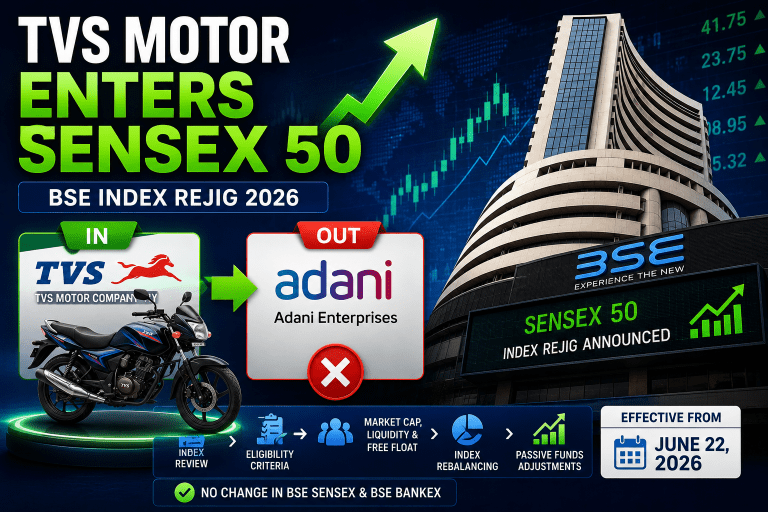
BSE Index Services has announced the latest reconstitution of several benchmark indices, bringing important changes to the composition of the BSE Sensex 50 and BSE 100 indices. As part of the periodic review, TVS Motor Company will replace Adani Enterprises in the BSE Sensex 50 index, with the changes becoming effective from June 22, 2026. Notably, there are no changes to the benchmark BSE Sensex and BSE Bankex indices in the latest review.
Index rebalancing is a routine exercise undertaken to ensure that benchmark indices continue to reflect the evolving structure of the market. Such changes often attract attention because passive funds, exchange-traded funds (ETFs), and index-tracking portfolios may adjust their holdings to align with the revised index composition.
This article explains why index reshuffles happen, the key changes announced by BSE, and how investors can interpret these developments.
Key Highlights
- TVS Motor Company will enter the BSE Sensex 50 index.
- Adani Enterprises will exit the BSE Sensex 50 index.
- The changes will take effect from June 22, 2026.
- No changes have been announced for the benchmark BSE Sensex or BSE Bankex.
- The BSE 100 index will also witness multiple additions and deletions.
What Is the Latest BSE Index Rejig?
BSE periodically reviews its indices to ensure they accurately represent the market based on factors such as market capitalization, liquidity and trading activity.
During the latest reconstitution exercise:
BSE Sensex 50
Added
- TVS Motor Company
Removed
- Adani Enterprises
BSE 100
Added
- Adani Enterprises
- Ashok Leyland
- One 97 Communications (Paytm)
- CG Power and Industrial Solutions
Removed
- TVS Motor Company
- Ambuja Cements
- Colgate-Palmolive India
- Tube Investments of India
The BSE Focused IT Index will also see L&T Technology Services replacing Cyient.
What Is the BSE Sensex 50 Index?
The BSE Sensex 50 is a broader benchmark that includes 50 large and liquid companies listed on the stock exchange.
The index is designed to:
- Represent major sectors of the economy
- Reflect market trends
- Serve as a benchmark for mutual funds and ETFs
- Help investors track broader market performance
Because the index contains some of the country’s most actively traded companies, changes in its composition often attract significant market attention.
Why Do Index Rebalancing Exercises Take Place?
Index providers regularly review constituents to ensure the index remains representative of the market.
Common factors considered include:
Market Capitalization
Companies with higher market value generally receive preference in broader benchmark indices.
Liquidity
Stocks must demonstrate adequate trading activity and investor participation.
Free-Float Availability
Only shares available for public trading are considered while calculating index eligibility.
Sector Representation
Indices aim to maintain balanced exposure across industries.
As company fundamentals, valuations and market participation evolve, index compositions are updated accordingly.
Why Was TVS Motor Added to Sensex 50?
Although index providers follow predefined methodologies, additions generally reflect stronger eligibility based on market capitalization, liquidity and free-float parameters.
TVS Motor has emerged as one of India’s leading automobile manufacturers and has witnessed increasing investor interest in recent years.
The company’s presence across:
- Motorcycles
- Scooters
- Electric vehicles
- International markets
has strengthened its market profile and visibility among institutional investors.
Its inclusion in the Sensex 50 highlights the growing importance of the automobile sector within Indian equity markets.
Why Was Adani Enterprises Removed?
Index exclusions do not necessarily indicate weakness in business fundamentals.
Instead, removals usually occur because other companies score better on index selection criteria during the review period.
Factors influencing index eligibility may include:
- Relative market capitalization
- Free-float market value
- Trading liquidity
- Ranking among eligible companies
It is important to note that Adani Enterprises continues to remain part of several important market indices and remains one of India’s largest listed companies by market value.
How Do Index Changes Impact Stocks?
Passive Fund Buying and Selling
Index-tracking mutual funds and ETFs replicate benchmark indices.
When a stock is added:
- Funds may purchase shares to align with index weightings.
When a stock is removed:
- Funds may reduce exposure accordingly.
This adjustment can create temporary trading activity around the implementation date.
Increased Institutional Visibility
Index inclusion can increase a company’s visibility among:
- Domestic institutional investors
- Foreign portfolio investors
- ETF providers
- Research analysts
Greater visibility may contribute to improved market participation over time.
Potential Liquidity Benefits
Stocks included in major benchmark indices often experience:
- Higher trading volumes
- Better liquidity
- Greater analyst coverage
However, the long-term performance of any stock ultimately depends on business fundamentals rather than index membership alone.
What Does the BSE 100 Reshuffle Indicate?
The latest BSE 100 changes reflect evolving market leadership across sectors.
The inclusion of companies such as Paytm, Ashok Leyland and CG Power suggests increasing investor interest in segments including:
- Financial technology
- Industrial manufacturing
- Capital goods
- Automotive businesses
Similarly, the exclusion of other constituents reflects the dynamic nature of Indian equity markets and the periodic reassessment undertaken by index providers.
What Should Investors Watch Next?
Investors may monitor:
Implementation Date
June 22, 2026, when the changes become effective.
Institutional Fund Flows
ETF and passive fund adjustments often occur around index implementation dates.
Trading Volumes
Changes in liquidity may become visible before and after inclusion.
Company Fundamentals
Revenue growth, profitability, market share and earnings remain more important than index membership over the long term.
Frequently Asked Questions (FAQs)
What is BSE index rebalancing?
BSE periodically reviews and updates index constituents based on predefined eligibility criteria such as market capitalization, liquidity and free-float market value.
Which company replaced Adani Enterprises in the Sensex 50?
TVS Motor Company replaced Adani Enterprises in the BSE Sensex 50 index.
When will the changes become effective?
The revised index composition will take effect from June 22, 2026.
Did the BSE Sensex witness any changes?
No. The latest review did not introduce any changes to the benchmark BSE Sensex index.
Why are stocks added or removed from indices?
Index providers review factors such as market capitalization, liquidity, free-float market value and sector representation while selecting constituents.
Does index inclusion guarantee higher stock returns?
No. Index membership may improve visibility and liquidity, but long-term stock performance depends on business fundamentals and market conditions.
Conclusion
The latest BSE index reconstitution reflects the dynamic nature of India’s equity markets. TVS Motor Company’s inclusion in the Sensex 50 and Adani Enterprises’ exclusion underscore how benchmark indices evolve to represent changing market trends and company rankings. While index changes can influence short-term fund flows and trading activity, investors should focus primarily on business fundamentals, earnings growth, competitive positioning and long-term value creation when evaluating companies.
Disclaimer
This article is for educational and informational purposes only and should not be construed as investment advice, stock recommendations or a solicitation to buy or sell securities. Investors should conduct their own research and consult a SEBI-registered investment adviser before making investment decisions. Investments in securities markets are subject to market risks. Read all related documents carefully before investing.