

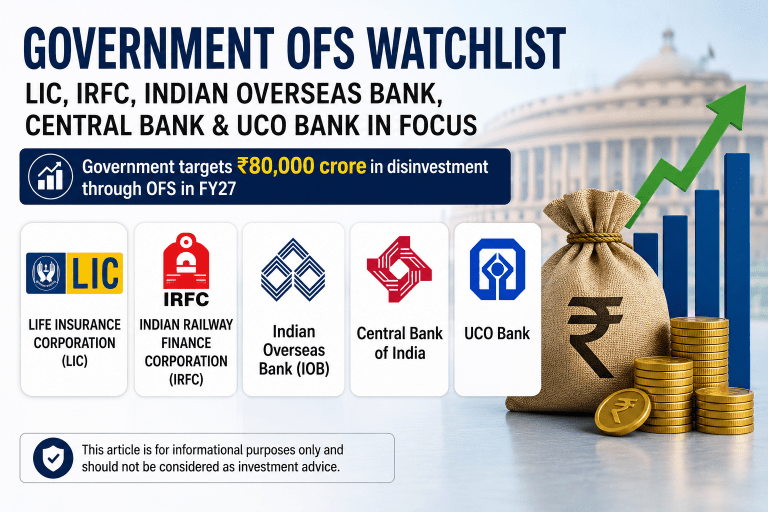
Several public sector companies, including Life Insurance Corporation (LIC), Indian Railway Finance Corporation (IRFC), Indian Overseas Bank (IOB), Central Bank of India, and UCO Bank, are drawing investor attention amid discussions around the Government of India’s ongoing disinvestment strategy.
The government has set an ambitious ₹80,000 crore capital receipts target for FY27, making stake dilution through the Offer for Sale (OFS) route an important avenue for raising funds while retaining management control of public sector enterprises.
Key Highlights
- Government aims to raise ₹80,000 crore through disinvestment and asset monetisation in FY27.
- PSU companies with higher government ownership are being closely watched for potential OFS.
- LIC, IRFC, Indian Overseas Bank, Central Bank of India and UCO Bank remain among the companies attracting market attention.
- No official OFS announcement has been made for most of these companies at the time of writing.
What is an Offer for Sale (OFS)?
An Offer for Sale (OFS) is a mechanism that allows promoters—including the Government of India—to sell shares in listed companies through the stock exchanges.
An OFS helps:
- Increase public shareholding.
- Improve market liquidity.
- Raise funds without issuing new shares.
- Support the government’s disinvestment programme.
Unlike a fresh equity issue, an OFS generally involves the sale of existing promoter-held shares.
Why Are These PSU Stocks Being Watched?
LIC
The government continues to hold a majority stake in LIC. As India’s largest life insurer, LIC remains one of the biggest public sector companies that could feature in future disinvestment plans, subject to market conditions and regulatory requirements.
IRFC
IRFC has already seen recent government stake sales through the OFS route. Investors continue to monitor any further stake dilution as part of the broader divestment programme.
Indian Overseas Bank (IOB)
With the government holding a significant ownership stake, Indian Overseas Bank remains among the public sector banks frequently discussed in relation to future disinvestment initiatives and minimum public shareholding norms.
Central Bank of India
Central Bank of India has also featured in the government’s recent stake dilution efforts, making it another PSU bank investors continue to watch for future announcements.
UCO Bank
UCO Bank is another government-owned lender with high promoter holding. Market participants continue tracking developments as the government works towards improving public shareholding over time.
Why Is the Government Using OFS?
The government typically uses the OFS route to:
- Meet fiscal and capital receipt targets.
- Increase public shareholding in PSUs.
- Enhance liquidity in listed government companies.
- Comply with regulatory shareholding norms.
- Generate non-tax revenue without relinquishing management control.
What Should Investors Watch?
Rather than reacting to speculation, investors may consider monitoring:
- Official announcements from DIPAM or the respective companies.
- Stock exchange filings.
- Government disinvestment updates.
- Quarterly financial performance.
- Valuation levels.
- Sector outlook.
- Market liquidity after any OFS announcement.
Potential OFS discussions do not necessarily indicate that a stake sale is imminent.
Frequently Asked Questions (FAQs)
What is an OFS?
An Offer for Sale (OFS) is a stock exchange mechanism through which promoters, including the Government of India, sell existing shares in listed companies.
Has the government officially announced OFS for all these companies?
No. While these companies are widely discussed as potential candidates due to their ownership structure and the government’s disinvestment strategy, official announcements have not been made for most of them.
Why are LIC and PSU banks being discussed?
These companies have relatively high government ownership, making them potential candidates as the government pursues its capital receipt and public shareholding objectives.
Does an OFS affect existing shareholders?
An OFS can influence short-term market sentiment and trading activity, but its long-term impact depends on company fundamentals, valuation, and investor demand.
Conclusion
LIC, IRFC, Indian Overseas Bank, Central Bank of India, and UCO Bank continue to remain on investors’ radar as the Government of India advances its FY27 disinvestment roadmap. While these companies are viewed as potential OFS candidates due to high government ownership, investors should rely on official disclosures and evaluate each company’s financial fundamentals before making investment decisions.
Disclaimer: This article is for educational and informational purposes only. It should not be construed as investment advice or a recommendation to buy, sell, or hold any security.