



ITC Ltd has witnessed a sharp correction of nearly 13% month to date, following the government’s notification to raise excise duties on cigarettes. The move has reignited long standing concerns around demand elasticity, illicit trade, and earnings visibility for the cigarette business, which remains a key profit driver for the company. While near-term sentiment has turned cautious, a deeper look at 30 years of historical data suggests that such corrections in ITC have often laid the groundwork for meaningful recoveries rather than prolonged downtrends.
ITC Share Price Correction: What Triggered the Fall?
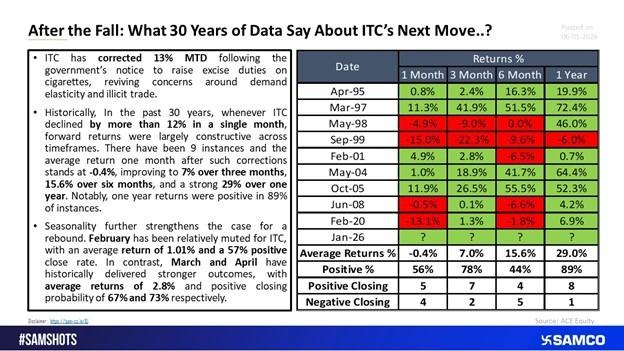
The recent decline in ITC shares is primarily driven by fears that higher excise duties could:
- Increase cigarette prices sharply
- Push consumers toward illicit and unregulated products
- Hurt legal industry volumes and government tax collections
Markets have reacted swiftly to this policy uncertainty, discounting potential risks to margins and volumes. However, history indicates that policy driven sell offs in ITC are not new, and their long-term impact has often been far less severe than initially feared.
Historical Performance After Sharp Corrections
An analysis of ITC’s performance over the past three decades reveals a consistent pattern. Whenever the stock has declined by more than 12% in a single month, forward returns have generally been constructive across medium- to long-term horizons.
Over the last 30 years:
- There have been 9 such instances of monthly corrections exceeding 12%
- The average return one month later stands at -0.4%, indicating short-term volatility
- Returns improve significantly over time, with:
- 7% average return after 3 months
- 15.6% average return after 6 months
- 29% average return after 1 year
Most notably, one-year returns were positive in 89% of these instances, highlighting that deep corrections have historically offered attractive entry points rather than marking structural weakness.
Role of Tax Hikes and Illicit Trade
Past episodes of aggressive tax hikes provide valuable lessons. Periods of steep increases in excise duties have often coincided with:
- A rise in illicit cigarette consumption
- Sub optimal revenue outcomes for the government
- Temporary pressure on legal industry volumes
However, these phases were frequently followed by policy normalization, improved compliance and recovery in legal sales. Markets, in hindsight, rewarded investors who looked beyond the immediate noise.
Seasonality: Why the Coming Months Matter?
Seasonal trends further strengthen the case for a potential rebound. Historically:
- February has been relatively muted for ITC, with an average return of 1.01% and a 57% positive close rate
- March and April, however, have delivered stronger outcomes:
- Average returns of 2.8%
- Positive closing probability of 67% and 73%, respectively
This seasonal tailwind, combined with a sharp prior correction, improves the odds of stabilization and recovery if policy actions remain measured.
What Should Investors Watch Next?
While historical data offers comfort, the outlook will hinge on one critical factor: the trajectory of taxation policy. If excise hikes remain incremental and predictable, the risk of volume disruption and illicit trade escalation stays contained. Conversely, aggressive and repeated hikes could prolong uncertainty.
Key variables to monitor include:
- Government stance on future tax increases
- Trends in illicit cigarette penetration
- Volume resilience and pricing power of ITC
- Management commentary on demand elasticity
Conclusion: Correction or Opportunity?
Although near term sentiment around ITC remains fragile, 30 years of data suggest that sharp, tax-driven corrections have more often been followed by normalization rather than sustained weakness. Long term investors may find reassurance in the stock’s historical resilience, provided policy risks do not escalate beyond expectations.
As always, the balance between taxation, compliance, and affordability will determine whether this correction becomes a temporary setback or another opportunity shaped by history.




 Easy & quick
Leave A Comment?