

Introduction
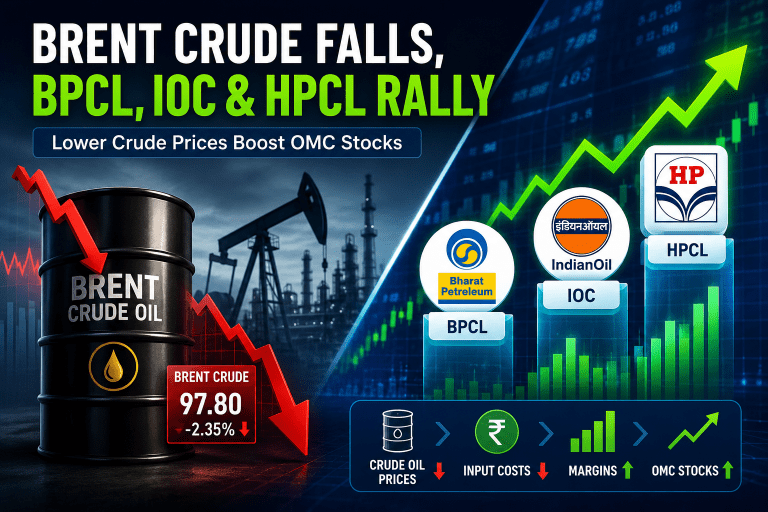
Shares of India’s leading oil marketing companies (OMCs), Bharat Petroleum Corporation Limited (BPCL), Indian Oil Corporation (IOC) and Hindustan Petroleum Corporation Limited (HPCL), witnessed strong buying interest after Brent crude oil prices declined significantly. The drop in international crude prices sparked optimism among market participants, as lower crude oil costs can potentially improve profitability for downstream oil companies.
Crude oil remains the most important raw material for OMCs. Any meaningful movement in global oil prices directly affects their refining operations, fuel marketing margins, inventory valuation and overall earnings performance. As Brent crude slipped below key levels, investors reassessed the earnings outlook for major Indian oil companies, resulting in a positive reaction in their stock prices.
While lower crude prices are generally considered beneficial for OMCs, several other factors—including fuel pricing policies, refining margins, foreign exchange fluctuations and global geopolitical developments—continue to influence the sector’s long-term outlook.
In this article, we explore why BPCL, IOC and HPCL shares moved higher, how falling crude oil prices impact oil marketing companies, key risks investors should monitor and what the development means for India’s energy sector.
Key Highlights
- BPCL, IOC and HPCL shares gained following a decline in Brent crude oil prices.
- Lower crude oil prices can reduce input costs for oil marketing companies.
- Improved marketing and refining margins may support earnings growth.
- Global supply-demand dynamics continue to influence crude oil prices.
- Government policies and fuel pricing decisions remain important variables for OMC profitability.
- Investors are closely tracking crude oil trends, refining margins and domestic fuel demand.
Why Did BPCL, IOC and HPCL Shares Rise?
The primary reason behind the rally in oil marketing company stocks was the decline in international crude oil prices.
Since BPCL, IOC and HPCL purchase crude oil as their key raw material, a fall in crude prices often improves market sentiment towards these companies. Lower procurement costs may translate into improved operating margins, provided retail fuel prices remain stable.
Market participants generally expect oil marketing companies to benefit from:
- Reduced crude procurement expenses
- Improved fuel marketing margins
- Better refining profitability
- Lower working capital requirements
- Improved cash flow generation
As a result, investors often view falling crude oil prices as a positive trigger for OMC stocks.
Understanding the Relationship Between Crude Oil Prices and OMC Stocks
To understand why BPCL, IOC and HPCL reacted positively, it is important to understand how the OMC business model works.
Oil marketing companies import crude oil from global markets and process it in refineries to manufacture products such as:
- Petrol
- Diesel
- Aviation turbine fuel
- LPG
- Kerosene
- Petrochemicals
The profitability of these companies depends largely on the difference between:
Cost of crude oil + operating expenses and selling price of refined products
When crude oil prices decline, the cost side of the equation becomes more favorable.
Lower Input Costs Can Improve Profitability
Crude oil accounts for a significant portion of operating expenses for oil marketing companies.
A decline in crude oil prices can:
- Lower production costs
- Improve gross margins
- Enhance operating leverage
- Support stronger earnings growth
This improvement becomes more meaningful if domestic fuel prices remain relatively unchanged during the same period.
Impact on Fuel Marketing Margins
Marketing margin refers to the difference between the retail selling price of fuel and the cost incurred by companies in supplying that fuel.
When crude prices decline and retail fuel prices remain stable:
- Marketing margins tend to improve
- Cash flow generation may increase
- Earnings visibility becomes stronger
This is one of the key reasons why investors often react positively to falling crude oil prices.
Refining Margins Also Play a Crucial Role
Apart from fuel marketing, refining operations contribute significantly to the earnings of BPCL, IOC and HPCL.
Refining profitability is commonly measured through Gross Refining Margin (GRM).
GRM represents the difference between:
- Value of petroleum products produced
- Cost of crude oil processed
Higher refining margins generally indicate stronger operational performance.
Although lower crude prices do not automatically guarantee higher GRMs, they can improve overall refinery economics under favorable market conditions.
What Is Brent Crude Oil?
Brent crude is one of the world’s most widely used benchmark crude oils.
It serves as a pricing reference for a large portion of internationally traded crude oil supplies.
Many countries, including India, closely monitor Brent crude prices because they influence:
- Fuel import costs
- Inflation trends
- Energy sector profitability
- Transportation costs
- Government fiscal management
As India imports a significant portion of its crude oil requirements, changes in Brent crude prices have a direct impact on the country’s energy ecosystem.
Why Brent Crude Matters for Indian Oil Companies
India remains one of the world’s largest consumers of petroleum products.
Since domestic production fulfills only a part of total demand, Indian refiners rely heavily on imported crude oil.
Consequently, fluctuations in Brent crude prices can affect:
Operating Costs
Higher crude prices increase procurement expenses.
Inventory Gains and Losses
Sharp movements in oil prices may create inventory-related gains or losses depending on stock levels.
Refining Economics
Changes in crude prices influence refining spreads and profitability.
Fuel Pricing Decisions
Government and industry pricing decisions often take global crude trends into account.
What Factors Are Influencing Crude Oil Prices?
Crude oil prices are affected by several interconnected global factors.
Geopolitical Developments
Political tensions and conflicts in major oil-producing regions can disrupt supply chains and create price volatility.
Investors frequently monitor developments in:
- Middle East countries
- Russia-related energy markets
- Global shipping routes
- Strategic petroleum reserves
Any reduction in geopolitical uncertainty can ease supply concerns and put downward pressure on oil prices.
OPEC+ Production Decisions
The Organization of the Petroleum Exporting Countries (OPEC) and its allies significantly influence global oil supply.
Production cuts generally support higher oil prices, while increased production can exert downward pressure.
Market participants closely track OPEC+ announcements because they can impact the earnings outlook of oil and gas companies worldwide.
Global Economic Growth
Economic growth drives energy demand.
Strong industrial activity typically increases fuel consumption, whereas slower economic growth may weaken oil demand.
Important indicators include:
- Manufacturing activity
- Industrial production
- Transportation demand
- Consumer spending
- Global GDP growth
China’s Energy Consumption
China is one of the largest consumers of crude oil globally.
Changes in Chinese demand can significantly affect international oil prices and broader market sentiment.
Impact on Different Types of Energy Companies
Not all energy companies respond similarly to falling crude oil prices.
Oil Marketing Companies
Companies such as BPCL, IOC and HPCL may benefit from lower crude costs because they purchase crude oil and sell refined products.
Potential benefits include:
- Improved margins
- Better cash flow
- Enhanced earnings visibility
Upstream Oil Producers
Companies involved in crude oil exploration and production may experience a different impact.
Since these businesses earn revenue from selling crude oil, lower oil prices can affect realizations and profitability.
Therefore, falling crude prices may not always be equally beneficial across the entire energy sector.
Key Risks Investors Should Monitor
Although declining crude oil prices may support OMC stocks, several risks remain.
Government Pricing Policies
Changes in fuel pricing mechanisms can influence profitability.
Inventory Losses
Rapid declines in crude prices may result in inventory valuation losses for companies holding higher-cost stock.
Currency Movements
Since crude oil imports are generally denominated in US dollars, fluctuations in the Indian rupee can impact import costs.
Weak Refining Margins
Even if crude prices decline, lower refining spreads can affect earnings.
Global Economic Slowdown
Weak demand conditions may impact fuel consumption and revenue growth.
Important Metrics to Track in OMC Stocks
Investors often monitor the following indicators:
| Metric | Importance |
|---|---|
| Brent Crude Oil Price | Determines input cost trends |
| Gross Refining Margin (GRM) | Measures refinery profitability |
| Marketing Margin | Indicates fuel retail profitability |
| USD-INR Exchange Rate | Impacts import costs |
| Fuel Demand Growth | Reflects consumption trends |
| OPEC+ Policy Decisions | Influences global oil supply |
| Inventory Levels | Affects inventory gains or losses |
Frequently Asked Questions (FAQs)
Why did BPCL, IOC and HPCL shares rise?
These stocks gained after Brent crude oil prices declined, as lower crude costs can potentially improve profitability for oil marketing companies.
How does falling crude oil benefit oil marketing companies?
Lower crude prices can reduce input costs, improve marketing margins and support better operating performance.
What is Brent crude oil?
Brent crude is a globally recognized benchmark used to price a significant portion of internationally traded crude oil.
Is falling crude oil always positive for OMC stocks?
Not necessarily. Other factors such as refining margins, government policies, inventory losses and fuel demand also influence profitability.
What is Gross Refining Margin (GRM)?
GRM measures the difference between the value of refined petroleum products and the cost of crude oil processed by a refinery.
Why is crude oil important for India?
India imports a substantial portion of its crude oil requirements, making international oil prices an important factor for inflation, fuel costs and energy sector profitability.
Conclusion
The recent rise in BPCL, IOC and HPCL shares highlights the close relationship between crude oil prices and the performance of oil marketing companies. As Brent crude oil declined, investors anticipated potential benefits from lower input costs, improved fuel marketing margins and stronger refining economics.
However, crude oil prices represent only one aspect of the investment landscape. Government policies, refining profitability, inventory management, currency movements and global economic conditions will continue to shape the outlook for India’s oil marketing sector.
For market participants seeking to understand energy sector trends, monitoring Brent crude oil prices alongside company-specific operational metrics remains essential for evaluating developments in OMC stocks.
Disclaimer
This article is intended solely for educational and informational purposes. It should not be construed as investment advice, stock recommendations, research reports, or an invitation to buy or sell securities. Investors should conduct their own research and consult a SEBI-registered investment adviser before making investment decisions. Investments in securities markets are subject to market risks. Read all related documents carefully before investing.