

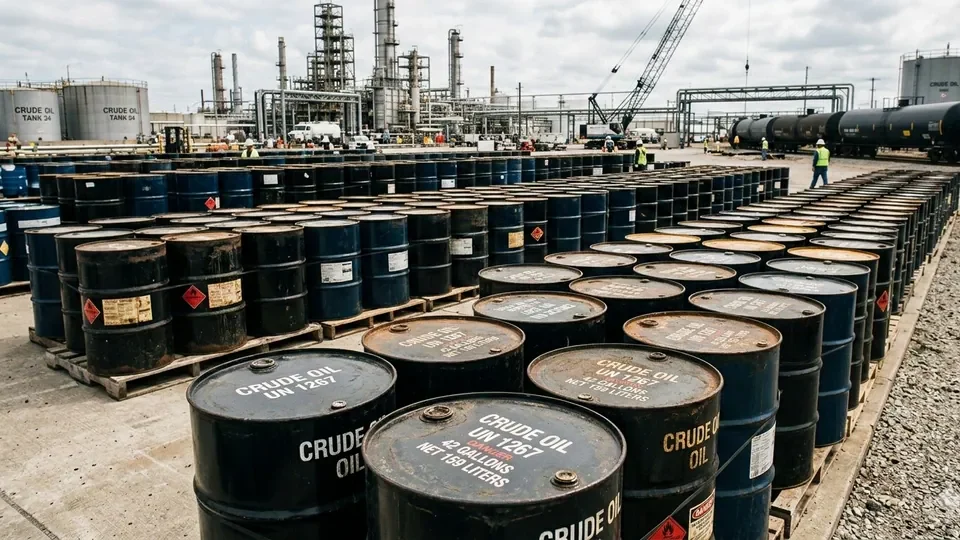
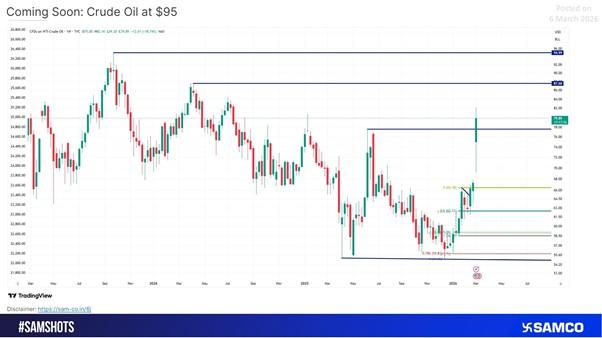
Crude oil may be entering a new bullish phase within the broader commodity supercycle. After months of consolidation, oil prices have started showing renewed strength and are currently trading around $82 per barrel.
The move signals that energy commodities could be the next leadership segment in the commodity cycle, especially after precious metals like gold and silver already delivered strong rallies.
Commodity markets often move in phases where leadership rotates between different sectors. Initially, precious metals lead during periods of uncertainty, followed by industrial and energy commodities as global economic expectations improve.
Recent price action suggests that crude oil may now be taking the lead.
Crude Oil Price Analysis: Why Oil Could Move Toward $95?
Technically, crude oil has broken out of a prolonged consolidation range.
Key observations from the chart analysis include:
- Crude oil recently crossed and sustained above the $77.5 level
- Prices opened with a gap-up move, signaling strong momentum
- The weekly candle structure suggests buyers remain in control
Key Resistance Levels
- $87 per barrel – Near-term resistance
- $95 per barrel – Major target zone
If momentum continues, crude oil could gradually move toward the $90–$95 range over the coming months.
The current price behavior indicates that the energy market could be entering a stronger phase of the commodity cycle.
Geopolitical Risks Supporting Higher Oil Prices
Another major factor supporting crude oil prices is rising geopolitical tensions, particularly the conflict involving the United States and Iran.
Energy markets are extremely sensitive to disruptions in the Strait of Hormuz, which is one of the world’s most important oil shipping routes.
Key facts about this route:
- Nearly 20% of global oil supply passes through the Strait of Hormuz
- Any disruption can quickly trigger supply concerns and price spikes
- Geopolitical tensions often result in risk premiums in oil prices
These developments are likely to keep oil prices elevated in the near term.
Gold-Crude Oil Ratio Signals a Potential Oil Rally
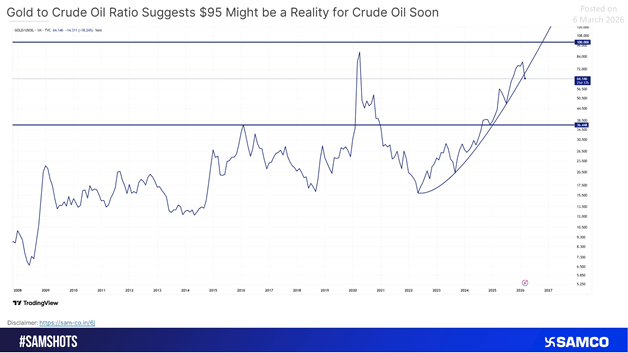
One of the most insightful indicators for commodity markets is the Gold-Crude Oil ratio.
This ratio measures how many barrels of crude oil are required to buy one ounce of gold.
It reflects the relationship between:
- Safe-haven demand (Gold)
- Growth-driven demand (Crude Oil)
Currently, the Gold-Crude Oil ratio is around 62, which is historically elevated.
Such high ratios usually do not persist for long periods and tend to normalize over time.
Scenario 1: If Crude Oil Price Remains Constant
Gold-Crude Ratio | Crude Oil Price | Implied Gold Price |
62 | $82 | $5084 |
55 | $82 | $4510 |
45 | $82 | $3690 |
Scenario 2: If Gold Price Remains Stable
Assuming gold stays around $5100, crude oil prices would adjust based on the ratio.
Gold-Crude Ratio | Gold Price | Implied Crude Oil Price |
62 | $5100 | $82 |
55 | $5100 | $92 |
45 | $5100 | $113 |
This analysis suggests that if the ratio compresses from 62 toward 55 or 45, crude oil prices could move toward:
- $95 per barrel
- Or even $110+ in a stronger cycle
This mathematical relationship supports the bullish outlook for crude oil.
Commodity Cycle Rotation: Precious Metals to Energy
The broader commodity cycle also supports this view.
Phase 1: Precious Metals Rally
Gold surged due to:
- Geopolitical tensions
- Global uncertainty
- Central bank buying
- Shifts in monetary policy
Phase 2: Silver Followed
Silver rallied later as:
- Industrial demand improved
- Economic expectations strengthened
Phase 3: Energy Commodities
Now, leadership appears to be shifting toward energy commodities like crude oil.
If this rotation continues, oil prices could enter a multi-month bullish phase.
Impact of Rising Crude Oil on the Nifty 50
The rise in crude oil prices has significant implications for Indian equity markets, especially the Nifty 50 index.
India is one of the largest crude oil importers in the world, which means higher oil prices directly impact the economy.
Why Rising Oil Prices Affect the Stock Market?
Higher crude oil prices typically lead to:
- Increased import bills
- Rising inflation
- Pressure on corporate margins
- Currency volatility
- Negative market sentiment
Because of these factors, Nifty and crude oil often move inversely.
Crude Oil vs Nifty: Inverse Correlation
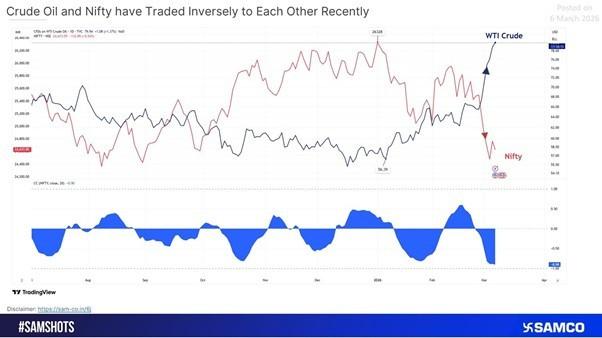
Recent market data shows a clear inverse relationship between crude oil and the Nifty 50.
- As crude oil surged toward $82, the Nifty index started weakening.
- Rising energy costs often act as a headwind for equities.
This relationship becomes even more important if crude oil moves toward $90–$95 levels.
Nifty 50 Technical Outlook
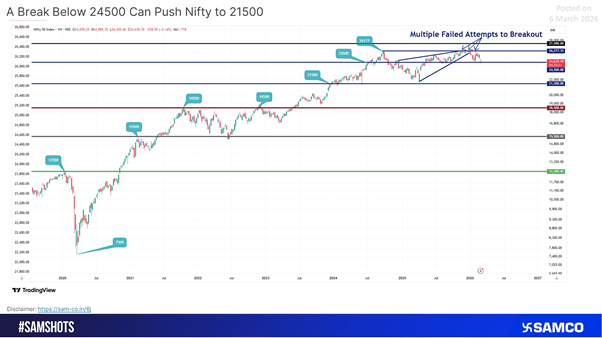
From a technical perspective, the Nifty index is facing strong resistance near the 26,200–26,300 zone.
The chart shows multiple failed breakout attempts, indicating strong selling pressure at higher levels.
Key Nifty Levels
Resistance
- 26,200 – 26,300
Support
- 24,500 (critical level)
If the index breaks below 24,500, it could trigger a deeper correction.
Next Major Support
- 21,500
This level represents previous consolidation zones and could act as the next structural support.
What Investors Should Watch Next?
Several factors will determine the next move in crude oil and equity markets.
Key Triggers
- Geopolitical developments
- Gold-Crude Oil ratio movement
- Global economic growth expectations
- Supply disruptions in energy markets
- Central bank policies
If crude oil continues its upward trajectory toward $90–$95, equity markets could experience heightened volatility.
Conclusion: Is Crude Oil Entering a New Bullish Phase?
Crude oil appears to be entering a stronger phase of the commodity supercycle.
Three major factors support this outlook:
- Commodity cycle rotation toward energy
- High Gold-Crude Oil ratio suggesting normalization
- Geopolitical tensions affecting supply routes
Technical indicators also suggest oil could move toward $87 and eventually $95 per barrel.
For India, this development carries important implications. Since the country heavily depends on oil imports, rising crude prices could pressure inflation, currency stability, and stock markets.
With the Nifty 50 approaching critical support near 24,500, investors should closely monitor both global energy markets and domestic equity trends.
The coming months could prove decisive for both crude oil prices and Indian equities.




 Easy & quick
Leave A Comment?