


Introduction
The Moving Average Convergence Divergence (MACD) is one of the most popular indicators used in technical analysis. Developed by Gerald Appel in the late 1970s, MACD helps traders identify trends, momentum shifts, and potential buying or selling opportunities.
Unlike many indicators that focus on a single aspect of price movement, MACD combines trend-following and momentum analysis into one powerful tool. This makes it particularly useful for both beginners and experienced traders.
Whether you’re an intraday trader looking for short-term opportunities or a swing trader seeking trend confirmation, understanding MACD can significantly improve your market analysis.
In this guide, we’ll explain how MACD works, how to interpret its signals, and how traders use it alongside other tools like
What is the MACD Indicator?
MACD stands for Moving Average Convergence Divergence.
It is a momentum indicator that shows the relationship between two moving averages of a stock’s price.
The indicator helps traders answer three key questions:
- Is the trend bullish or bearish?
- Is momentum increasing or decreasing?
- Is a potential reversal developing?
Because it combines trend and momentum analysis, MACD is widely used in technical analysis across stocks, indices, commodities, forex, and cryptocurrencies.
How Does MACD Work?
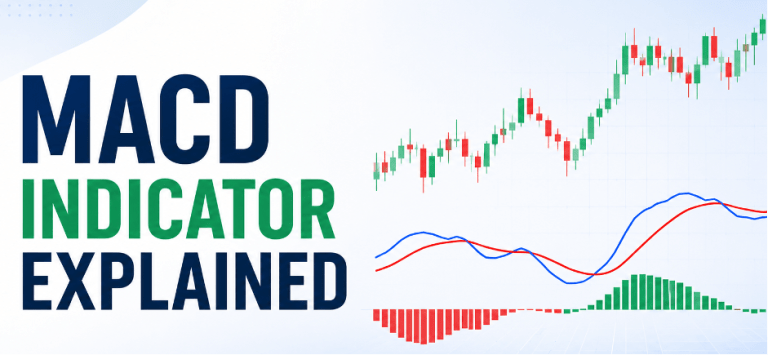
The MACD indicator consists of three components:
1. MACD Line
The MACD line is calculated by subtracting the 26-period Exponential Moving Average (EMA) from the 12-period EMA.
When the MACD line rises, bullish momentum is strengthening.
When it falls, bearish momentum is increasing.
2. Signal Line
The signal line is a 9-period EMA of the MACD line.
It acts as a trigger line for buy and sell signals.
Traders closely monitor the interaction between the MACD line and the signal line.
3. Histogram
The histogram measures the difference between the MACD line and the signal line.
A rising histogram indicates increasing momentum.
A shrinking histogram suggests weakening momentum.
Many traders consider the histogram an early warning system for trend changes.
Why is MACD Popular Among Traders?
MACD remains one of the most widely used indicators because it offers:
- Trend identification
- Momentum analysis
- Entry and exit signals
- Reversal indications
- Confirmation for other setups
Unlike some indicators that work only in specific market conditions, MACD performs reasonably well across multiple timeframes and trading styles.
Understanding MACD Buy Signals
One of the most common bullish signals occurs when the MACD line crosses above the signal line.
This is known as a bullish crossover.
When this happens:
- Momentum begins improving
- Buying interest increases
- Potential uptrend may develop
Many traders use bullish crossovers as potential entry opportunities.
However, successful traders rarely rely on MACD alone. They often seek confirmation through candlestick patterns or support and resistance levels.
Understanding MACD Sell Signals
A bearish crossover occurs when the MACD line crosses below the signal line.
This suggests:
- Momentum is weakening
- Selling pressure is increasing
- Trend reversal may be developing
Bearish crossovers often help traders identify potential exit opportunities or downside risk.
What is MACD Divergence?
Divergence occurs when price and MACD move in opposite directions.
This is considered one of the strongest MACD signals.
Bullish Divergence
Bullish divergence occurs when:
- Price forms lower lows
- MACD forms higher lows
This indicates selling pressure is weakening even though price continues declining.
Bullish divergence often appears before upward reversals.
Bearish Divergence
Bearish divergence occurs when:
- Price forms higher highs
- MACD forms lower highs
This suggests bullish momentum is weakening despite rising prices.
Bearish divergence can signal potential downside risk.
MACD in Trending Markets
MACD performs best during strong trends.
In an uptrend:
- MACD stays above zero
- Bullish crossovers occur frequently
- Momentum remains positive
In a downtrend:
- MACD stays below zero
- Bearish signals dominate
- Selling pressure remains strong
This makes MACD particularly useful for swing trading strategies.
MACD and the Zero Line
The zero line plays an important role in MACD analysis.
Above Zero
When MACD remains above zero:
- Bullish momentum dominates
- Trend remains positive
Below Zero
When MACD remains below zero:
- Bearish momentum dominates
- Market sentiment remains weak
Many traders use the zero line as an additional trend filter.
Combining MACD with Support and Resistance
One of the most effective ways to improve MACD accuracy is to combine it with support and resistance.
Example:
A stock approaches a major support zone while MACD generates a bullish crossover.
This creates stronger confirmation because both price action and momentum support the trade idea.
Similarly, bearish MACD signals near resistance zones often carry greater significance.
MACD and RSI: Better Together
Many traders use MACD and the RSI indicator together.
While MACD focuses on trend and momentum, RSI measures overbought and oversold conditions.
For example:
A bullish MACD crossover combined with RSI moving out of oversold territory can create a high-probability setup.
Using both indicators together helps reduce false signals.
MACD with Candlestick Patterns
Professional traders often combine MACD with candlestick patterns for additional confirmation.
Examples include:
- Bullish Engulfing Pattern
- Hammer Pattern
- Morning Star Pattern
- Bearish Engulfing Pattern
- Shooting Star Pattern
When a strong candlestick reversal appears alongside a MACD signal, confidence in the trade setup increases.
MACD for Intraday Trading
Intraday traders use MACD to:
- Identify momentum shifts
- Confirm breakout trades
- Spot trend reversals
- Improve entry timing
Popular intraday timeframes include:
- 5-minute chart
- 15-minute chart
MACD works best when combined with volume and price action.
MACD for Swing Trading
MACD is particularly effective for swing traders.
Daily charts often produce cleaner signals compared to lower timeframes.
Swing traders use MACD to:
- Capture multi-day trends
- Identify pullback entries
- Confirm trend continuation
- Detect momentum reversals
Because of its trend-following nature, MACD remains one of the most trusted indicators for swing trading.
Common Mistakes Traders Make
Using MACD Alone
No indicator should be used in isolation.
Always combine MACD with:
- Price action
- Market structure
- Risk management
Trading Every Crossover
Not every crossover results in a profitable trade.
Market context remains critical.
Ignoring Trend Direction
Bullish signals in strong downtrends often fail.
Similarly, bearish signals during strong uptrends can be unreliable.
Neglecting Risk Management
Even high-quality setups can fail.
Always define stop-loss levels before entering trades.
Advantages of MACD
MACD offers several benefits:
- Easy to understand
- Combines trend and momentum
- Works across markets
- Useful for beginners
- Effective on multiple timeframes
- Strong trend confirmation tool
Limitations of MACD
Like all indicators, MACD has limitations.
These include:
- Lagging nature
- False signals during sideways markets
- Delayed entries after sharp reversals
- Reduced effectiveness in low-volatility conditions
Understanding these limitations helps traders use MACD more effectively.
Final Thoughts
The MACD indicator is one of the most reliable tools in technical analysis for identifying trend direction, momentum shifts, and potential trading opportunities.
Its simplicity, versatility, and effectiveness have made it a favourite among traders worldwide.
However, MACD should not be used in isolation. Combining it with support and resistance, candlestick patterns, the RSI indicator, and sound risk management can significantly improve trading outcomes.
For beginners building a foundation in market analysis, mastering MACD is an important step toward becoming a more confident and disciplined trader.
Frequently Asked Questions
What does MACD stand for?
MACD stands for Moving Average Convergence Divergence.
Is MACD a leading or lagging indicator?
MACD is primarily a lagging indicator because it is based on moving averages.
Which timeframe is best for MACD?
Daily charts are often preferred for swing trading, while 5-minute and 15-minute charts are commonly used for intraday trading.
Is MACD better than RSI?
Both indicators serve different purposes. MACD focuses on trend and momentum, while RSI identifies overbought and oversold conditions.
Can beginners use MACD?
Yes. MACD is one of the most beginner-friendly indicators in technical analysis.