

If there is one concept that every successful trader understands before using indicators like RSI, MACD, or Moving Averages, it is support and resistance.
These two levels form the backbone of technical analysis and help traders identify potential buying zones, selling zones, breakout opportunities, and risk management levels. Whether you’re an intraday trader, swing trader, or long-term investor, understanding support and resistance can significantly improve your decision-making process.
In fact, many professional traders build their entire trading strategy around support and resistance levels because they reflect the ongoing battle between buyers and sellers in the market.
In this guide, you’ll learn what support and resistance are, why they work, how to identify them on charts, and how to use them effectively in real-world trading scenarios.
What is Support in the Stock Market?
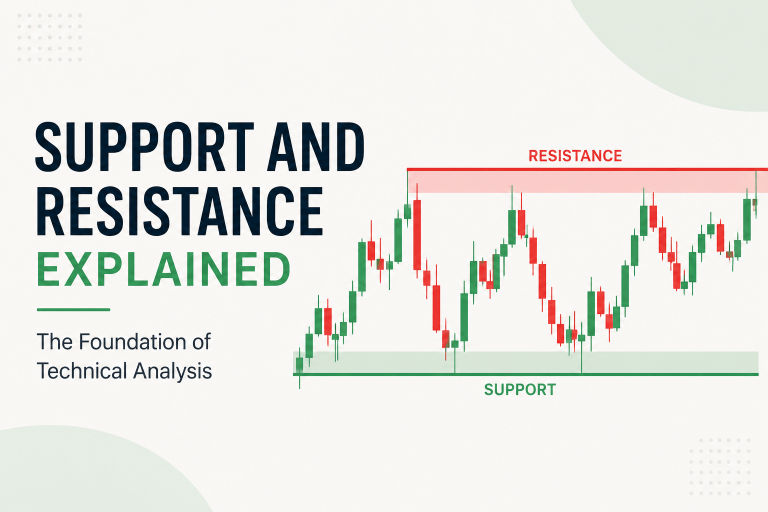
Support is a price level or zone where a stock tends to stop falling because buying interest becomes strong enough to absorb selling pressure.
When prices decline, investors and traders often start looking for attractive entry points. If enough buyers believe a stock is undervalued at a particular price, demand increases and the decline slows down or reverses.
Think of support as a floor beneath the stock price.
For example, suppose a stock repeatedly falls near ₹500 and then bounces higher. After observing this behaviour multiple times, traders begin identifying ₹500 as a support zone.
The key word here is “zone.”
Support is rarely an exact number. Instead, it is usually an area where buyers are expected to become active.
What is Resistance?
Resistance is the opposite of support.
It is a price zone where selling pressure becomes strong enough to prevent further upward movement.
As stock prices rise, investors who purchased at lower levels may start booking profits. At the same time, some traders may consider the stock expensive and initiate fresh selling positions.
As a result, supply increases and price struggles to move higher.
Think of resistance as a ceiling above the stock price.
For example, if a stock repeatedly reaches ₹700 and fails to move higher, traders begin treating ₹700 as a resistance level.
Just like support, resistance should be viewed as a zone rather than a precise price point.
Why Support and Resistance Work
Many beginners assume support and resistance are magical lines on a chart. In reality, they work because of market psychology.
Financial markets are driven by human emotions such as fear, greed, hope, and regret.
Imagine a trader who missed buying a stock when it was trading at ₹500. If the stock falls back to that level again, the trader may see it as a second opportunity and decide to buy.
Similarly, investors who purchased near ₹700 and experienced a decline may decide to sell if the stock returns to that level, simply to recover their losses.
When thousands of market participants think in a similar way, support and resistance levels naturally develop.
This collective behaviour creates recurring price zones that traders can identify and use for decision-making.
How to Identify Support and Resistance
One of the biggest mistakes beginners make is overcomplicating the process.
Support and resistance can often be identified by simply looking at historical price action.
1. Previous Swing Highs and Swing Lows
The easiest method is to identify areas where price has reversed multiple times in the past.
If a stock repeatedly bounces from a particular level, it may represent support.
If it repeatedly reverses from a certain higher level, it may represent resistance.
The more times price reacts to a level, the stronger that support or resistance zone becomes.
2. Trendlines
Trendlines can also act as dynamic support and resistance.
In an uptrend, a rising trendline often supports the price whenever temporary pullbacks occur.
In a downtrend, a falling trendline can act as resistance and limit upward movement.
Many traders combine trendline analysis with candlestick patterns to improve trade accuracy.
3. Moving Averages
Popular moving averages frequently act as dynamic support and resistance levels.
The most commonly used averages include:
- 20 EMA
- 50 EMA
- 100 DMA
- 200 DMA
During strong uptrends, prices often pull back to a moving average before resuming higher.
Similarly, moving averages can act as resistance during downtrends.
This is why moving averages remain one of the most widely used tools in technical analysis.
4. Psychological Price Levels
Round numbers often become important support and resistance zones.
Examples include:
- ₹100
- ₹500
- ₹1,000
- ₹5,000
- ₹10,000
Investors naturally pay more attention to round figures, which creates increased buying or selling activity around these levels.
Support Turning Into Resistance
One of the most powerful concepts in trading is role reversal.
When a support level breaks, it often becomes future resistance.
Let’s assume a stock had strong support at ₹500 for several months.
Eventually, selling pressure increases and the stock falls below ₹500.
Now traders who bought near ₹500 may become nervous and look to exit if the stock returns to that level.
As a result, the old support starts acting as resistance.
This phenomenon is observed across stocks, indices, commodities, and currencies.
Resistance Turning Into Support
The opposite also happens frequently.
When a stock breaks above resistance, that resistance often becomes new support.
Suppose a stock struggles to move above ₹700 for several weeks.
Eventually, buyers gain control and price breaks above ₹700 with strong volume.
If the stock later pulls back toward ₹700, buyers may once again become active.
The old resistance level now becomes support.
This concept is widely used in breakout trading strategies.
Using Support and Resistance in Trading
Support and resistance are not just theoretical concepts. They are practical tools that traders use every day.
Buying Near Support
Many traders look for buying opportunities near support zones because risk can be clearly defined.
If the support level fails, they can exit the trade with a relatively small loss.
If support holds, the stock may provide a favourable reward-to-risk opportunity.
Selling Near Resistance
Traders may also consider reducing positions or booking profits near resistance levels.
Since resistance often attracts selling pressure, prices may struggle to move significantly higher.
Trading Breakouts
Some traders avoid buying near support altogether and instead focus on breakouts.
When price successfully breaks above resistance with strong volume, it can indicate the beginning of a new upward trend.
Similarly, breakdowns below support can signal continued weakness.
Combining Support and Resistance with Candlestick Patterns
Support and resistance become significantly more powerful when combined with candlestick patterns.
For example:
Bullish Setup
A Hammer candlestick forming near support can indicate that buyers are regaining control.
Bearish Setup
A Shooting Star near resistance may signal weakening bullish momentum.
Price action confirmation helps traders avoid false signals and improve trade quality.
Using RSI with Support and Resistance
Many traders combine support and resistance with the RSI Indicator.
Imagine a stock approaching a major support zone while RSI falls below 30.
This indicates the stock is oversold and approaching an area where buyers have historically emerged.
Such confluence often creates stronger trading opportunities.
Similarly, a stock near resistance with RSI above 70 may indicate overbought conditions and potential downside risk.
Combining multiple tools increases confidence and reduces reliance on a single indicator.
Common Mistakes Beginners Make
Treating Levels as Exact Numbers
Support and resistance should be viewed as zones, not precise prices.
Stocks frequently move slightly above or below these levels before reversing.
Ignoring Market Trends
Support and resistance work best when analysed alongside broader market trends.
Buying every support level in a strong downtrend can be dangerous.
Trading Without Confirmation
Many beginners enter trades simply because price touches support or resistance.
Professional traders usually wait for confirmation through:
- Price action
- Candlestick patterns
- Volume analysis
- Momentum indicators
Ignoring Risk Management
No support or resistance level works 100% of the time.
Always use stop-loss orders and proper position sizing.
Good risk management is more important than predicting market direction.
Advantages of Support and Resistance
Support and resistance remain popular because they are:
- Easy to understand
- Applicable across all markets
- Useful for beginners and professionals
- Effective for identifying entry and exit points
- Helpful in risk management
- Compatible with multiple trading styles
Whether you trade stocks, commodities, forex, or cryptocurrencies, these concepts remain universally relevant.
Limitations of Support and Resistance
Despite their usefulness, support and resistance are not perfect.
Markets can produce:
- False breakouts
- Temporary violations
- Sudden news-driven moves
- High volatility events
This is why successful traders combine support and resistance with other tools rather than relying on them exclusively.
Final Thoughts
Support and resistance are among the most important concepts every trader should master.
They help identify areas where buyers and sellers are likely to become active, improve trade timing, and provide a framework for managing risk.
While many traders become obsessed with complicated indicators and strategies, experienced market participants often begin their analysis by identifying support and resistance levels.
When combined with technical analysis, candlestick patterns, moving averages, volume analysis, and the RSI indicator, support and resistance can become powerful tools for navigating the stock market with greater confidence.
FAQs
What is support in technical analysis?
Support is a price zone where buying interest is strong enough to prevent or slow down further decline in a stock’s price.
What is resistance in the stock market?
Resistance is a price zone where selling pressure limits further upward movement in a stock.
Can support become resistance?
Yes. Once support breaks, it often acts as resistance if the price revisits that level later.
Is support and resistance useful for intraday trading?
Yes. Intraday traders frequently use support and resistance to identify entry points, stop-loss levels, and breakout opportunities.
Which indicator works best with support and resistance?
Many traders combine support and resistance with the RSI indicator, moving averages, volume analysis, and candlestick patterns for better confirmation.