

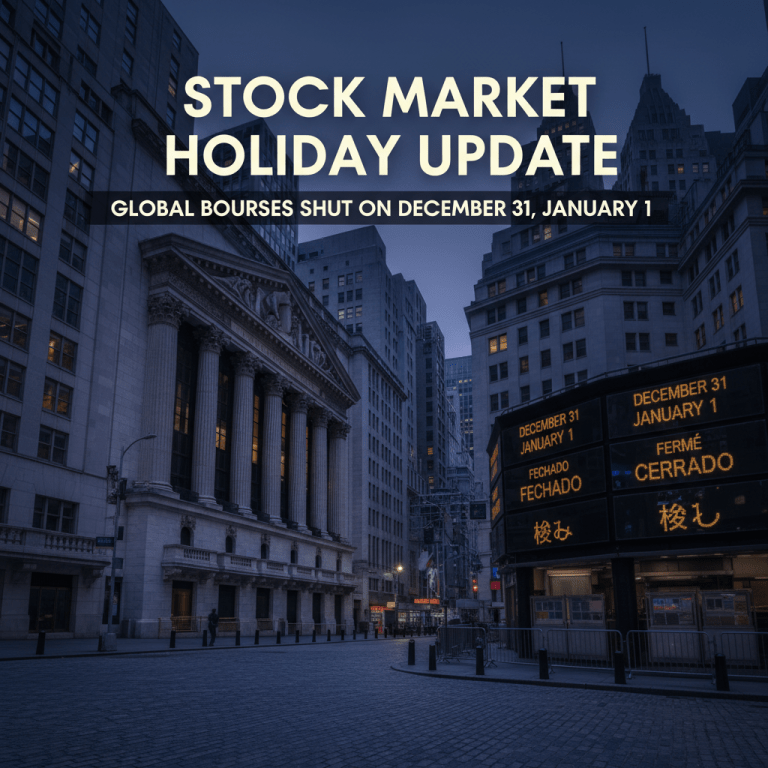
As the calendar turns and markets wrap up another year, stock market holidays come into sharp focus. The final two trading days of the year—December 31 and January 1—carry a different rhythm altogether. Globally, trading desks thin out, volumes dry up, and most large institutions step aside.
Yet, India stands slightly apart.
While much of the world pauses, Dalal Street stays open, offering Indian investors a full trading week—even as global cues remain muted.
Market Performance: Year-End Quiet Sets In Globally
The closing days of the year are typically calm across global markets. This time is no different.
With New Year holidays across multiple regions, most global stock exchanges are either:
- Fully closed
- Operating with shortened trading sessions
As a result:
- Institutional investors have largely squared off positions
- Liquidity remains thin
- Market moves are narrow and often directionless
This is a pattern seen year after year, and the current trading week fits that familiar mold.
Main News: Stock Market Holiday Schedule for December 31
On December 31, several major stock exchanges across Asia and Europe will not operate normally.
Some will shut completely. Others will close early.
Key Markets Affected on December 31
- Early close in markets like:
- Australia
- New Zealand
- Hong Kong
- United Kingdom
- Spain
- Full market holiday in:
- Japan
- South Korea
Interestingly, while much of the world slows down, the US stock market remains open for trading on December 31.
This split trading environment often leads to uneven global cues, with selective markets driving sentiment.
Stock Market Holiday on January 1: Global Shutdown
The picture changes more decisively on January 1, as New Year’s Day brings a near-global trading halt.
Across regions:
- Asia: China, Japan, Hong Kong, South Korea, Taiwan shut operations
- Oceania: Australia and New Zealand closed
- Europe: Germany, France, UK, and most European exchanges closed
- United States: NYSE observes a market holiday
By sheer scale, January 1 is among the most widely observed stock market holidays worldwide.
Why This Matters for Indian Markets?
Despite global markets largely shutting down for the year-end and New Year, Indian stock exchanges will continue trading on both December 31 and January 1.
According to the official holiday calendar:
- BSE: Open
- NSE: Open
There is no stock market holiday in India on either day.
However, being open does not always mean being active.
Dalal Street: Open, But With Subdued Activity
Even as Indian markets continue trading, the global holiday effect does not disappear.
Historically, these sessions are marked by:
- Low institutional participation
- Limited global triggers
- Narrow movement in benchmark indices
The tone is usually cautious, with traders preferring to wait rather than take aggressive positions.
Global markets often act as a compass for Indian equities, and when that compass is still, direction becomes harder to find.
What Lies Ahead on the Holiday Calendar?
For investors tracking upcoming stock market holidays, it’s important to note:
- January 26, 2026 will be the first official trading holiday of the new year in India
- The day marks Republic Day, observed by both NSE and BSE
Until then, Indian markets operate on a full schedule, even as global peers gradually return from the holiday break.
Summary: Stock Market Holiday Mood Dominates, India Trades On
To sum it up:
- December 31 and January 1 see widespread global stock market holidays
- Many international exchanges are either closed or operating for shorter hours
- Indian markets remain open, with no trading holidays on these days
- Trading activity is expected to be light, reflecting global inactivity
- Directional clarity usually improves once global institutions return
In the final stretch of the year, the market isn’t rushing. It’s catching its breath.
For Indian investors, it’s less about action—and more about observation—as the world flips the calendar and waits for fresh momentum in the days ahead.