

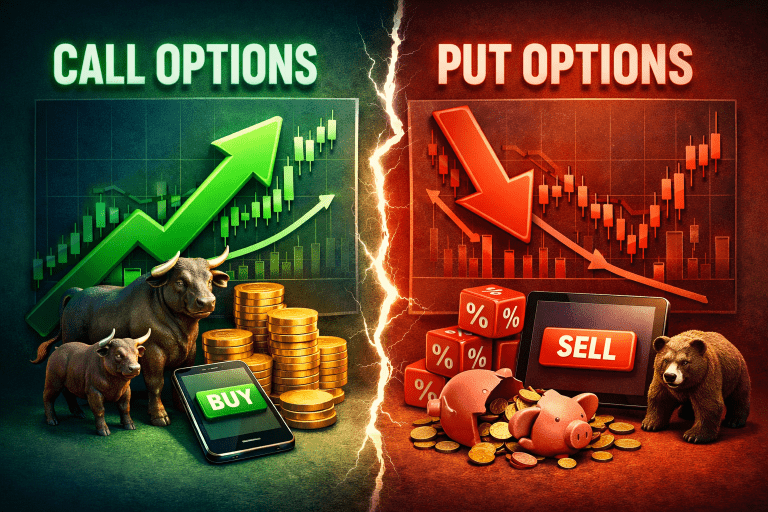
Call and put options are contracts that give you the right to buy or sell stocks at a fixed price before a certain date. They are among the most popular derivatives in the share market because they let you make profits with small upfront money and manage risk smartly. Whether you expect prices to rise or fall, call and put option trading gives you flexible ways to trade. This guide breaks down everything you need to know about call and put options in plain language, with real examples you can use right away.
What Is a Call Option?
A call option is a contract that gives you the right to buy an asset at a fixed price on or before a set date. You are not forced to buy. You can choose to buy only if it makes sense for you.
Think of it like a reservation at a restaurant. You pay a small fee upfront to book a table. If you decide to show up and eat, you get the table at the price you agreed on. If you don’t want to eat, you just lose the small fee. With a call option, you pay a premium (the small fee) to have the right to buy a stock at a strike price (the agreed price).
Key Points About Call Options
- You expect the stock price to rise
- You pay a premium upfront (your maximum loss)
- Your profit potential is unlimited
- You benefit when the market moves up
- Time works against you as expiry approaches
Call Option Example
Suppose Nifty is trading at 22,000 on February 13, 2026. You believe the market will go up soon.
- You buy a 22,200 call option (strike price)
- You pay ₹150 as premium (per share)
- The lot size for Nifty options is typically 50
- Your total cost = ₹150 × 50 = ₹7,500
If Nifty rises to 22,400 on expiry, your call put option becomes profitable. The option is now worth (22,400 – 22,200) × 50 = ₹10,000. After subtracting your premium cost, your profit is ₹10,000 – ₹7,500 = ₹2,500.
If Nifty falls to 21,900, the option expires worthless. You lose the entire premium of ₹7,500. This is your maximum loss.
What Is a Put Option?
A put option is a contract that gives you the right to sell an asset at a fixed price on or before a set date. With a put, you profit when prices fall instead of rise.
Imagine you own a house and worry the property market might crash. You can buy insurance that lets you sell your house at today’s price even if it falls later. A put option works the same way. You pay a small premium to have the right to sell at a fixed price, even if the market drops.
Key Points About Put Options
- You expect the stock price to fall
- You pay a premium upfront (your maximum loss)
- Your profit is limited but useful for protection
- You benefit when the market moves down
- Commonly used to hedge long positions
Put Option Example
Suppose Nifty is trading at 22,000 on February 13, 2026. You think the market will fall soon.
- You buy a 21,800 put option (strike price)
- You pay ₹120 as premium (per share)
- The lot size is 50
- Your total cost = ₹120 × 50 = ₹6,000
If Nifty falls to 21,600 on expiry, your put option makes money. The option is now worth (21,800 – 21,600) × 50 = ₹10,000. After subtracting your premium, your profit is ₹10,000 – ₹6,000 = ₹4,000.
If Nifty rises to 22,200, the option expires worthless. You lose the entire premium of ₹6,000. Again, this is your maximum loss.
Key Differences Between Call and Put Options
Understanding how call and put options differ helps you choose the right tool for your market view. Here are the main differences:
|
Feature |
Call Option |
Put Option |
|
Market View |
Bullish (price will rise) |
Bearish (price will fall) |
|
Right Given |
Right to buy |
Right to sell |
|
Profit When |
Price rises above strike + premium |
Price falls below strike – premium |
|
Maximum Loss |
Premium paid |
Premium paid |
|
Profit Potential |
Unlimited |
Limited (strike price) |
|
Common Use |
Bet on price rise, leverage |
Protection, hedging |
The core difference is simple: buy a call when you think prices will rise, buy a put when you think prices will fall.
Types of Call and Put Options
Options are grouped into three types based on their strike price and current market price. This matters because it affects how much they cost and how likely they are to make money.
In-the-Money (ITM)
An option is in-the-money when it has intrinsic value right now. For a call, it means the stock price is above the strike price. For a put, it means the stock price is below the strike price. ITM options are more expensive because they have built-in profit potential.
At-the-Money (ATM)
An option is at-the-money when the stock price equals the strike price. ATM options have no intrinsic value yet, but they are right at the boundary. They are moderately priced and offer balanced risk and reward.
Out-of-the-Money (OTM)
An option is out-of-the-money when it has no intrinsic value. For a call, the stock price is below the strike. For a put, the stock price is above the strike. OTM options are cheap because they require a bigger price move to become profitable. Beginners often chase OTM options for cheap premiums, but this is risky.
Think of it this way: ITM options are like owning a profitable business (costs more but safer). OTM options are like lottery tickets (very cheap but need a big move to win).
Call Put Option Trading Explained
Call put option trading involves two main roles: buyers and sellers. Most beginners start as buyers. Understanding both sides helps you trade smarter.
Buying Options (Long Position)
When you buy a call or put option, you pay a premium upfront. Your maximum loss is the premium you paid. Your profit depends on how much the underlying asset moves in your favor. Buying is simple and less risky because you know your maximum loss from day one.
Selling Options (Option Writing)
When you sell a call or put option, you take the premium from a buyer. But now your risk is higher. If the market moves against you, your losses can be large. Sellers need to keep margin (extra money) with their broker. Beginners should avoid selling options until they have real trading experience.
Buyer vs Seller Perspective
- Buyer pays premium, has limited loss, unlimited or limited profit potential
- Seller receives premium, has unlimited or large loss potential, limited profit
- Time decay helps sellers (premium shrinks as expiry nears)
- Time decay hurts buyers (premium shrinks as expiry nears)
For beginners, buying options is the right starting point. You control your risk clearly.
When to Choose Call or Put Option?
Your market outlook should guide your choice of call or put option. Here are real situations where each makes sense:
Buy a Call When
- You expect prices to rise soon
- A stock shows strong momentum and breaking technical levels
- Economic news is positive for a sector
- You want leverage on a small budget
- A company is about to announce good results
Buy a Put When
- You expect prices to fall
- A stock is trading near resistance and showing weakness
- Bad economic news affects a sector
- You own stocks and want to protect profits (hedging)
- Market sentiment is turning negative
Special Strategies
If you expect big moves but are unsure of direction, you can buy both a call and a put at different strikes. This is called a straddle. You profit if the market moves sharply in either direction. The cost is higher, but the flexibility is valuable.
If you hold a stock long-term and want downside protection, buy a put on that stock. This lets you keep the stock but limits your loss if the market crashes.
Practical Real-Life Trading Example
Let’s walk through a complete example to show how call and put options work in real trading.
Call Option Trading Example
Scenario: Today is February 13, 2026. Bank Nifty is trading at ₹45,000. You expect a positive budget announcement next week and believe Bank Nifty will rise.
Your trade:
- Stock/Index: Bank Nifty
- Strike Price: 45,500 call
- Premium Paid: ₹250 per share
- Lot Size: 40 shares
- Total Investment: ₹250 × 40 = ₹10,000
Break-Even Point: 45,500 + 250 = 45,750. Bank Nifty needs to reach 45,750 just for you to break even.
Profit Scenario: Bank Nifty rises to 46,200 by expiry. Your option is worth (46,200 – 45,500) × 40 = ₹28,000. After subtracting your premium, profit = ₹28,000 – ₹10,000 = ₹18,000 on a ₹10,000 investment. This is a 180% return.
Loss Scenario: Bank Nifty falls to 44,800 by expiry. The option expires worthless. You lose the entire ₹10,000 premium. This is your maximum loss.
Put Option Trading Example
Scenario: You own Bank Nifty shares worth ₹1,80,000 (40 shares at 45,000). You worry about market risk next week.
Your hedge trade:
- Stock/Index: Bank Nifty
- Strike Price: 44,500 put
- Premium Paid: ₹180 per share
- Lot Size: 40 shares
- Total Cost: ₹180 × 40 = ₹7,200
Protection Benefit: If Bank Nifty crashes to 43,000, your put option is worth (44,500 – 43,000) × 40 = ₹60,000. Your loss on shares is (45,000 – 43,000) × 40 = ₹80,000. But the put profit of ₹60,000 reduces your net loss. Total loss = ₹80,000 – ₹60,000 + ₹7,200 (premium) = ₹27,200. Without the put, you would have lost ₹80,000.
Cost of Protection: If Bank Nifty rises to 46,500, your put expires worthless. You lose ₹7,200 premium. But your shares gain ₹60,000. Net profit = ₹60,000 – ₹7,200 = ₹52,800. This shows the real cost of insurance.
Advantages of Call and Put Options
Options offer real benefits that make them valuable tools for traders and investors:
Limited Risk for Buyers
When you buy a call or put option, your maximum loss is the premium you paid. You know this upfront. You can sleep at night knowing exactly how much you can lose.
Leverage
Options let you control large positions with small money. A ₹10,000 investment in options can give returns equal to a ₹2,00,000 stock investment if the market moves right. This leverage amplifies returns.
Hedging Ability
Put options protect your stock holdings like insurance. If you own expensive stocks and fear a crash, buy puts. Your profit is capped by the premium, but your loss is protected.
Flexibility
You can profit in bull markets (buy calls), bear markets (buy puts), or sideways markets (sell premiums). Options work in any market condition.
Lower Capital Requirement
Options need far less upfront money than buying stocks outright. This is why many retail traders prefer options to stock trading.
Risks Involved
Options are powerful but dangerous if you don’t understand the risks. Here’s what can go wrong:
Time Decay
Every day that passes, the premium of an option shrinks. This is called theta decay. Even if the stock price doesn’t move, your option loses value just because time is passing. OTM options decay fastest. If you buy OTM options and the stock doesn’t move as expected, you lose money even if you were right about direction eventually.
Volatility Risk
When market swings increase, option premiums rise. When volatility falls, premiums fall. You can buy a call and the stock can move up, but if volatility crashes, the premium might still fall. This is called vega risk.
Wrong Strike Selection
Many beginners buy far OTM options (out-of-the-money) because they are cheap. But these options need huge price moves to be profitable. Often they expire worthless. Smart traders choose ATM or near-ATM options for better odds.
Premium Erosion
Options lose value as expiry approaches, especially if they are still OTM. A ₹50 premium can become ₹10 in the final week even if the stock price doesn’t change. Your investment erodes like ice in the sun.
Emotional Trading
Options move fast and swings are sharp. This tempts traders to hold too long hoping for recovery, or exit too early in panic. Stick to your plan and use stop-loss orders always.
Common Mistakes Beginners Make
Learning from others’ mistakes helps you avoid expensive losses. Here are the top errors:
Buying Far Out-of-the-Money Options
The premium is cheap (maybe ₹10), so you buy 10 options thinking you can make huge returns. But the stock needs to move 50% just for you to break even. Most of the time, this doesn’t happen. You lose the entire amount. Stick to ATM or ITM options with better odds.
Ignoring Expiry Date
Options lose value as expiry approaches. If you buy a weekly option on Thursday and sell on Wednesday of expiry week, time decay will have eaten into your gains even if the stock price moved right. Buy monthly or weekly options based on your expected move timing.
Not Using Stop-Loss
A small loss can become a total loss if you don’t cut it early. Always decide your stop-loss price before entering a trade. If the option falls to that price, exit immediately. Many traders hold losers hoping for recovery and lose everything.
Trading Without a Clear View
Don’t buy options because the premium looks cheap. Buy options only when you have a real reason to believe the price will move in your chosen direction. Random trades based on hope fail 80% of the time.
Overtrading
The low cost of options tempts you to take many small trades. Most lose. Fewer, bigger, well-planned trades work better. Quality beats quantity in options trading.
Conclusion
Call and put options are powerful tools for traders who understand them well. A call option lets you profit when prices rise with limited downside risk. A put option lets you profit when prices fall or protect your holdings. The key difference is market direction: calls are bullish, puts are bearish. By learning when to use each tool and avoiding common mistakes, you can build a profitable options trading approach. Remember that options require discipline, clear market views, and proper risk management. Start small, learn from real trading, and grow your skills over time as you gain confidence in call put option trading.
FAQs
Q1: What is call and put option in share market?
A call and put option are derivative contracts. A call option gives you the right to buy an asset at a fixed price before expiry. A put option gives you the right to sell an asset at a fixed price before expiry. Both involve paying a premium upfront. Calls profit when prices rise, puts profit when prices fall. They are tools for trading and hedging in the share market.
Q2: What is the difference between call and put option?
The main differences are: a call is bullish (you profit when price rises), a put is bearish (you profit when price falls). With a call, you gain the right to buy. With a put, you gain the right to sell. A call has unlimited profit potential, but a put’s profit is limited to the strike price minus premium. Both have the same maximum loss (the premium paid). Use calls for upside plays and puts for downside protection or bearish bets.
Q3: When should I buy call or put option?
Buy a call when you expect the price to rise soon and you have specific reasons (positive news, technical breakout, strong trend). Buy a put when you expect the price to fall or when you own a stock and want to protect it. Also buy a put if you see technical weakness or negative sector news. The key is having a clear market view backed by some analysis, not just guessing.
Q4: Is call put option trading risky?
Buying call and put options is as risky as you make it. If you buy one call option as a small part of your portfolio, your risk is limited to the premium (say ₹5,000). This is acceptable. But if you take 10 options with borrowed money or bet your entire capital on one trade, the risk is very high. Start small, use stop-losses, and never trade money you can’t afford to lose. Proper risk management makes options safe.
Q5: Can beginners trade call and put options?
Yes, beginners can trade options, but they must learn first. Start by understanding what calls and puts are (which you now do). Paper trade first (trade without real money) to build confidence. Start with buying options only, not selling. Use small position sizes. Never use leverage or borrowed funds in the beginning. Choose ATM or slightly ITM options for better odds. After 6-12 months of consistent profits, you can explore advanced strategies. Knowledge first, then real money.