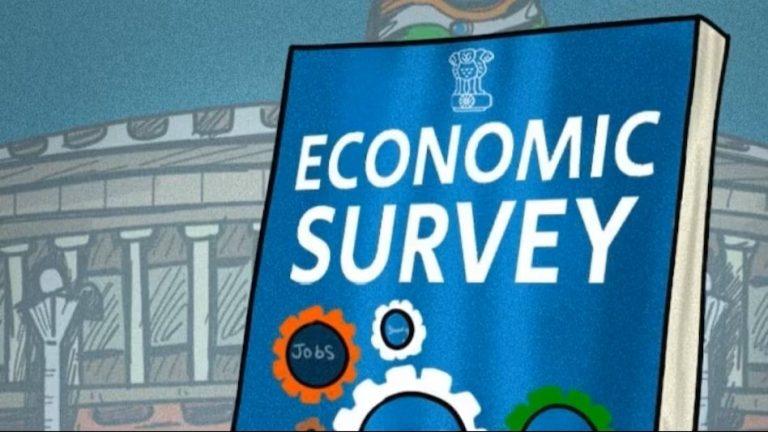
The Economic Survey 2026, presented ahead of the Union Budget, paints a nuanced picture of the global economy. While the world has managed to sustain growth and trade better than anticipated, the survey warns that resilience may be deceptive. The full effects of rising geopolitical tensions, trade disruptions, and financial vulnerabilities could unfold with a lag, posing risks to markets everywhere.
Market Performance: Signs of Global Fragility
Global financial markets are already reflecting these underlying vulnerabilities. Key indicators highlight growing investor caution:
- Gold prices surged from $2,607 per ounce in 2025 to $4,315, signaling a weakening US dollar and concerns over persistent negative real interest rates.
- The upward trend continued into 2026, with gold climbing 30% to $5,600 per ounce in international markets.
- The Global Economic Policy Uncertainty Index remains near its highest levels since 2020, underscoring persistent anxiety among investors worldwide.
These movements suggest markets are factoring in the fragility highlighted by the Economic Survey.
Three Global Scenarios for 2026
The Economic Survey outlines three distinct global scenarios, ranging from moderately optimistic to deeply concerning.
1. Managed Disorder – Best-Case Scenario (40–45% Probability)
In this scenario, the global economy mirrors 2025 conditions, but with a thinner margin of safety. Minor shocks could escalate, causing temporary volatility, but systemic collapse is avoided.
- Financial stress episodes, trade frictions, and geopolitical tensions create fluctuations, requiring governments to intervene more actively.
- Volatility may be higher, but overall market mechanisms and policies prevent a chain reaction of crises.
2. Disorderly Multipolar Breakdown – Moderate Risk (40–45% Probability)
This outcome signals rising geopolitical tensions and fragmented global trade:
- Conflicts such as Russia-Ukraine could remain unresolved, creating destabilizing pressure.
- Trade policies become increasingly coercive; sanctions and restrictions reshape supply chains under political influence.
- Financial stress events are transmitted across borders more easily, with fewer buffers and weaker institutional safeguards.
- National priorities dominate, forcing countries to navigate sharp trade-offs between growth, stability, and autonomy.
3. Systemic Shock Cascade – High-Impact, Low-Probability (10–20% Probability)
The survey highlights a potential crisis scenario surpassing the 2008 Global Financial Crisis (GFC):
- Highly leveraged technology and AI investments could trigger financial shocks if corrections occur, tightening global liquidity.
- Simultaneous geopolitical escalation or trade disruption could amplify effects, producing widespread risk aversion.
- Off-balance-sheet financing in technology infrastructure and rising government bond yields in markets like Japan are early warning signs.
- Lack of global coordination compared to the 2008 GFC increases the potential severity of this scenario.
Implications for India
Despite global vulnerabilities, India is relatively well-positioned:
- Strong macroeconomic fundamentals and a large domestic market act as buffers.
- A less financialized growth model and healthy foreign exchange reserves provide shock absorption.
However, the survey points out that India is not immune to external shocks, especially regarding capital flows and the rupee:
- Foreign portfolio investors (FPIs) have net sold ₹41,280 crore in Indian stocks so far this year (as of 28 January), the highest in the past 12 months.
- The rupee has weakened nearly 6% in a year, recently breaching 92 against the US dollar.
The survey emphasizes a strategy of “strategic sobriety”: prioritizing domestic growth while maintaining buffers, redundancy, and liquidity to navigate the uncertain global landscape.
Key Takeaways
- Global risks are real but vary in probability: from managed disorder to potential crises exceeding 2008 levels.
- Markets are already reflecting fragility, with gold prices and policy uncertainty indices signaling caution.
- India remains relatively resilient, but capital outflows and currency depreciation require careful management.
- Strategic readiness—buffers, liquidity, and domestic growth focus—will be essential for navigating 2026.
The Economic Survey 2026 provides a clear lens on global uncertainty, highlighting that while India stands on solid footing, vigilance is critical in a world of rising geopolitical, financial, and technological risks.
Source: Livemint