

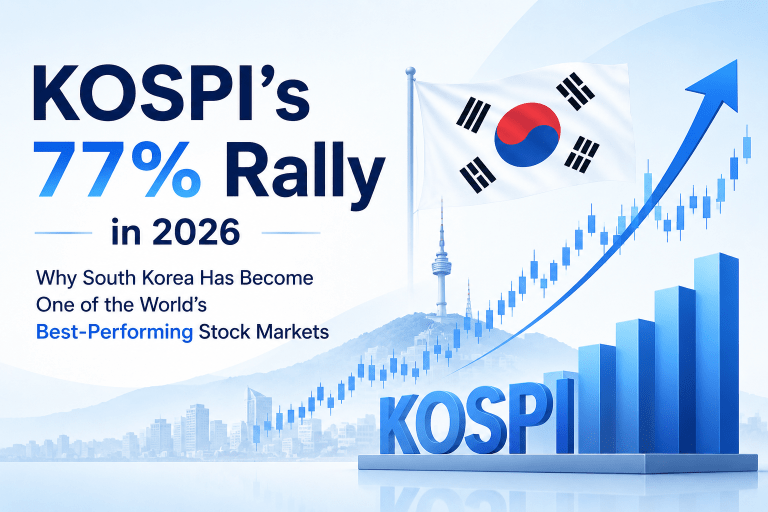
South Korea’s benchmark stock index, the KOSPI, has emerged as one of the strongest-performing equity markets globally in 2026. The index gained nearly 77% year-to-date by early May, outperforming several major developed and emerging markets. The rally has been powered by a combination of artificial intelligence (AI)-driven semiconductor demand, improving corporate earnings, foreign institutional inflows, and governance reforms aimed at enhancing shareholder value.
While global investors continue to focus on U.S. technology giants, South Korea has quietly become one of the biggest beneficiaries of the AI infrastructure boom.
Summary
- The KOSPI surged around 77% in 2026, making it one of the world’s best-performing stock indices.
- Rising demand for AI hardware and memory chips significantly boosted earnings expectations for South Korean companies.
- Semiconductor leaders such as Samsung Electronics and SK Hynix became major drivers of market performance.
- Foreign investors increased allocations to Korean equities amid strong earnings growth and relatively attractive valuations.
- Corporate governance reforms helped reduce the historical “Korea Discount” that had weighed on stock valuations for years.
What Is the KOSPI?
The KOSPI (Korea Composite Stock Price Index) is South Korea’s primary stock market benchmark and tracks the performance of major companies listed on the country’s main exchange. It includes globally recognized businesses across technology, automotive, manufacturing, healthcare, and financial services sectors.
In 2026, the index repeatedly reached new all-time highs, crossing major milestones that reflected renewed investor confidence in the country’s economic outlook.
Why Has South Korea’s Stock Market Rallied So Strongly?
1. The Global AI Boom Created Massive Demand for Memory Chips
Artificial intelligence has become the biggest investment theme in global markets.
AI data centers, cloud computing infrastructure, and advanced computing systems require large quantities of high-performance memory chips. South Korea is home to some of the world’s leading memory semiconductor manufacturers, placing the country at the center of this structural trend.
As demand for AI hardware accelerated, earnings expectations for semiconductor companies improved significantly, driving higher stock prices across the market.
Key Takeaway
South Korea is not merely participating in the AI revolution—it supplies critical components that enable it.
2. Semiconductor Giants Led the Rally
A substantial portion of the KOSPI’s gains came from large technology companies.
Samsung Electronics achieved a market capitalization exceeding $1 trillion during the rally, while SK Hynix also experienced significant gains as investors anticipated stronger AI-related revenues.
These companies represent a large share of the index, meaning their performance had an outsized impact on overall market returns.
3. Corporate Governance Reforms Improved Investor Sentiment
For years, investors applied a valuation discount to Korean stocks due to concerns around corporate governance, shareholder returns, and capital allocation practices.
Recent reform initiatives focused on:
- Improving transparency
- Increasing shareholder engagement
- Encouraging higher dividends and buybacks
- Enhancing capital efficiency
These measures helped attract greater international investment and improved confidence in Korean equities.
4. Strong Earnings Growth Supported Valuations
One reason analysts have viewed the rally differently from speculative bubbles is that earnings expectations have risen alongside stock prices.
Several market observers noted that profit growth—not simply valuation expansion—has been the primary driver behind the market’s advance. In some cases, earnings forecasts increased so rapidly that valuation multiples remained stable or even declined despite rising share prices.
This distinction is important because sustainable bull markets are typically supported by improving corporate fundamentals.
5. Foreign Capital Flows Returned to Korean Equities
International investors increased exposure to South Korea during 2026 as:
- Semiconductor demand strengthened
- Economic conditions stabilized
- Corporate reforms gained traction
- Earnings expectations improved
Foreign institutional buying contributed additional momentum to the rally and reinforced positive market sentiment.
Is South Korea’s Market Becoming an Alternative AI Investment Destination?
Many investors seeking exposure to AI have traditionally focused on U.S. technology companies.
However, South Korea offers a different investment proposition.
Instead of betting on which AI software company will dominate the future, Korean companies often participate through the supply chain that powers AI infrastructure itself. This includes memory chips, advanced manufacturing, electronics components, and semiconductor equipment.
As AI adoption expands globally, demand for these technologies could continue supporting Korean corporate earnings.
Risks Investors Should Watch
Despite impressive gains, investors should remain aware of potential risks:
Market Concentration
A large portion of the KOSPI’s performance has been driven by a handful of technology and semiconductor companies. Any slowdown in AI-related demand could affect market sentiment.
Valuation Concerns
After rapid appreciation, some investors may question whether expectations have become too optimistic, increasing the possibility of short-term corrections.
Global Economic Uncertainty
Changes in interest rates, geopolitical developments, trade policies, and technology spending cycles could influence future market performance.
What Can Indian Investors Learn from the KOSPI Rally?
The South Korean market’s performance highlights how structural themes can create long-term wealth creation opportunities.
Key lessons include:
- Innovation-driven sectors can transform entire markets.
- Earnings growth matters more than short-term price momentum.
- Governance reforms can significantly influence valuations.
- Global capital tends to flow toward markets benefiting from powerful secular trends.
- Investing in ecosystem leaders can sometimes be more effective than chasing end-user applications.
Conclusion
South Korea’s KOSPI has become one of the standout performers of 2026, driven by AI-led semiconductor demand, improving corporate profitability, foreign investment inflows, and governance reforms. While risks remain, the rally demonstrates how structural technological shifts can reshape entire stock markets. For global investors, South Korea has emerged as a key market to watch as the AI investment cycle continues to evolve.
Disclaimer
This article is intended solely for informational and educational purposes. It should not be construed as investment advice, stock recommendation, or financial guidance. Stock market investments are subject to market risks. Investors should conduct their own research and consult a SEBI-registered financial advisor before making any investment decisions