The US-Iran war has rattled global markets. And on Monday morning, Indian equities felt the heat immediately.
When the opening bell rang, panic was visible. The Sensex plunged more than 2,700 points in early trade. It later recovered part of the losses, but by 10:30 am, it was still trading nearly 1,000 points lower.
The Nifty 50 hovered around 24,850 during that time.
This isn’t just another volatile session. The US-Iran war has triggered deep concern about crude oil prices, corporate earnings, and India’s economic stability.
Let’s break down what’s really happening.
Market Performance: Oil Shock Hits Sentiment First
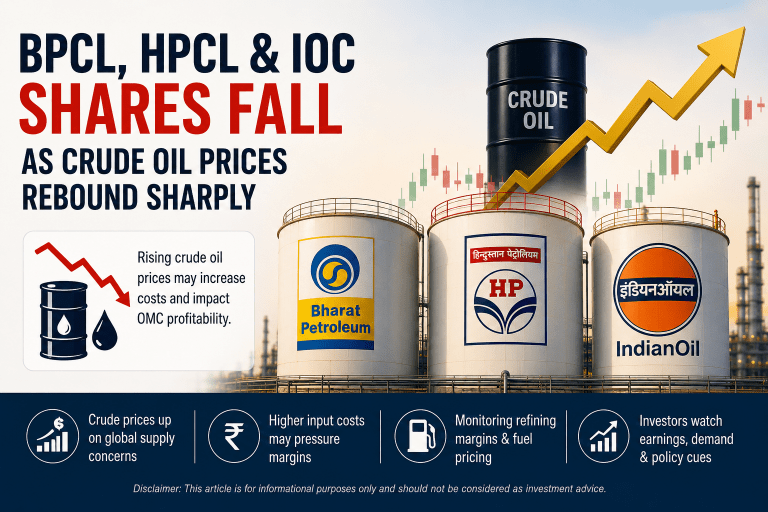
The first reaction to the US-Iran war was visible in oil prices. And that matters more to India than most people realise.
India imports a large portion of its crude oil requirement. So any spike directly impacts:
- Inflation
- Fiscal balance
- Corporate input costs
- Profit margins
Crude oil is not just fuel. It is a base raw material for multiple industries — from chemicals to paints, aviation to logistics.
A sharp rise in crude prices increases operational costs. That eats into profitability.
This fear is what pushed the markets into panic mode.
The early crash of 2,700 points on the Sensex reflected anxiety around:
- Prolonged war risk
- Supply disruption in the Middle East
- Energy price shock
- Potential slowdown in corporate earnings
Even after partial recovery, the damage to sentiment was clear.
The US-Iran war is not just geopolitical news. For Dalal Street, it is about economics.
Why the Middle East Matters So Much to Indian Companies?
The Middle East is a key revenue engine for several Indian companies.
From infrastructure to IT services, construction to retail jewellery — many firms derive a significant share of revenue from this region.
A prolonged US-Iran war creates risks such as:
- Business disruption
- Project execution delays
- Payment cycles getting stretched
- Currency volatility
- Reduced government spending in Gulf nations
When investors see uncertainty around these markets, stock prices react swiftly.
Let’s look at companies with meaningful exposure.
Companies with Significant Middle East Exposure
Larsen & Toubro (L&T)
Larsen & Toubro has deep operational roots in West Asia.
In Q3FY26, international revenues contributed 54% of total revenues. That’s more than half.
Over the past few years, the company secured multiple large-value contracts in the Middle East. The region has been a strong driver of growth.
Key Financial Data:
- Order inflows in FY25: ₹3,56,631 crore
- Growth driven largely by Middle East investment momentum
- Strong capex support from Government of India as well
However, market reaction was sharp.
- The stock crashed 7.5% intraday on the BSE on March 2.
The market’s logic is simple. If the US-Iran war escalates, infrastructure spending in the region could slow or face execution challenges.
That’s where the nervousness comes from.
Tata Consultancy Services (TCS)
Tata Consultancy Services also has notable exposure to the MEA (Middle East and North Africa) region.
In Q3FY26, revenue from MEA:
- Rose 8.3% year-on-year
- Contributed meaningfully to overall revenue
This growth came at a time when revenues from key markets like India and the UK declined.
That makes MEA strategically important.
Market Reaction:
- Share price declined over 3%
- Hit a 52-week low of ₹2,551.55
When markets see revenue concentration in a war-sensitive geography, the stock comes under pressure.
The US-Iran war is amplifying that concern.
KEC International
KEC International has ongoing projects across the Middle East.
In its Q3FY26 earnings call, the company highlighted its strategic focus on expanding its footprint in the region.
Key Business Highlights:
- Secured its third international order for a pipeline laying project in the Middle East
- Identified the region as a key growth engine
- Significant opportunities across:
- Saudi Arabia
- UAE
- Oman
Market Reaction:
- Stock crashed nearly 12%
- Hit a 52-week low of ₹517.90 on the BSE
The exposure that once looked like a growth catalyst is now viewed through the lens of geopolitical risk.
VA Tech Wabag
VA Tech Wabag is actively executing projects in the Middle East.
In its December quarter presentation, the company outlined digitalisation plans across plants in India and the Middle East.
Current Executions in Saudi Arabia:
- 200 MLA Al Haer STP project
- 300 MLD Yanbu Mega Desalination Plant
Market Reaction:
- Stock crashed over 12% intraday on the BSE
Large on-ground projects mean operational dependency on regional stability. That’s what the market is pricing in.
Kalyan Jewellers
Kalyan Jewellers has major retail presence in the Middle East.
In Q3FY26, revenue from the region:
- Increased nearly 28%
The growth momentum from Gulf countries has been strong.
Market Reaction:
- Share price dropped more than 4% intraday
The concern isn’t about performance today. It’s about uncertainty tomorrow.
If the US-Iran war impacts consumer sentiment or mobility in Gulf economies, discretionary sectors could feel the impact.
Oil: The Core of the US-Iran War Market Reaction
The entire market tremor comes back to oil.
The Middle East controls a significant share of global crude production and supply routes. Any threat to supply creates an immediate spike in prices.
For India, elevated oil prices mean:
- Higher import bills
- Pressure on the rupee
- Higher transportation costs
- Margin compression across sectors
That’s why the US-Iran war is not just geopolitics — it’s macroeconomics.
How the Broader Market Reacted?
Here’s what we saw in numbers:
- Sensex down over 2,700 points at open
- Recovered partially but still down nearly 1,000 points by 10:30 am
- Nifty 50 around 24,850
Stocks with direct Middle East exposure saw sharper cuts.
The market is differentiating between domestic-focused companies and globally exposed firms.
Market Sentiment: Fear of Prolonged Conflict
Right now, the concern is duration.
Short conflict. Markets adjust.
Long conflict. Oil sustains higher levels. Corporate costs increase. Fiscal math gets tighter.
That’s the background in which the US-Iran war is being evaluated.
Investors are not just reacting to today’s news. They are anticipating secondary impacts.
Summary: What the US-Iran War Means for Indian Markets?
The US-Iran war has triggered:
- A sharp early crash of over 2,700 points in the Sensex
- Continued weakness with nearly 1,000-point loss mid-morning
- Pressure on companies heavily dependent on Middle East revenues
- Concerns over rising crude oil prices
Companies like:
- Larsen & Toubro
- Tata Consultancy Services
- KEC International
- VA Tech Wabag
- Kalyan Jewellers
saw notable declines due to their Middle East exposure.
The core risk remains crude oil volatility and potential disruption in regional operations.
At this stage, markets are reacting to uncertainty. Numbers tell the story. Sentiment explains the rest.
The US-Iran war has become the key variable for Dalal Street this week.
Source: Livemint