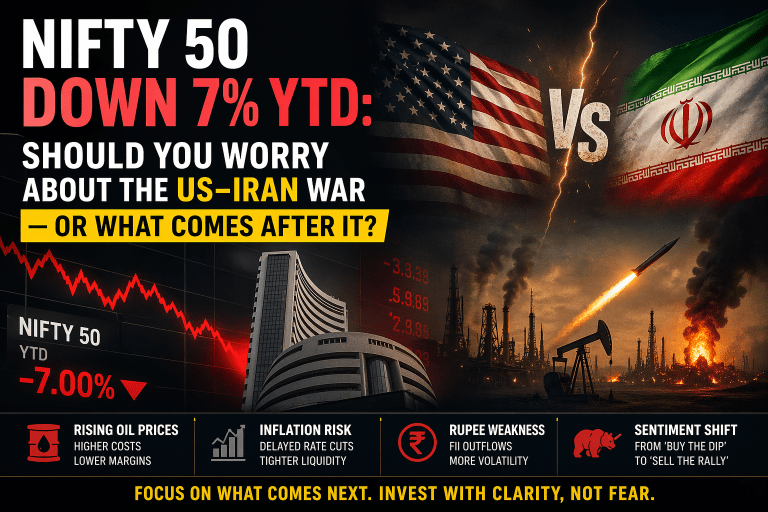
A 7% correction in the Nifty 50 has triggered a familiar reaction among investors: concern, confusion, and the urge to act.
The narrative is straightforward — rising geopolitical tensions between the US and Iran have pushed crude oil higher, weakened sentiment, and dragged equity markets lower.
But markets don’t move on events alone.
They move on what those events change.
And that’s where most investors misread the situation.
What Triggered the 7% Fall in Nifty 50? (First-Order Impact)
At a surface level, the chain reaction looks obvious:
- Escalation in US–Iran tensions
- Crude oil prices surge
- Inflation fears rise
- Global markets turn risk-off
This is the first-order impact — immediate and highly visible.
But here’s the problem:
By the time retail investors react to first-order news, markets have already priced it in.
The Real Risk: Second-Order Effects of the US–Iran Conflict
The real market impact lies beneath the surface — in second-order effects that unfold gradually but drive long-term trends.
1. Rising Crude Oil → Pressure on Corporate Margins
India imports more than 80% of its crude oil.
Sustained high oil prices increase costs across sectors:
- FMCG (higher input and logistics costs)
- Aviation (fuel cost surge)
- Chemicals and manufacturing
- Transportation and logistics
Initially, companies absorb these costs.
But over time:
Margins compress → Earnings weaken → Valuations adjust
2. Inflation Risk → Delayed Rate Cuts → Liquidity Tightens
Higher oil prices directly impact inflation.
If inflation remains elevated:
- RBI may delay interest rate cuts
- Borrowing costs stay high
- Liquidity conditions tighten
This leads to:
Valuation compression — even before earnings decline shows up clearly
3. Rupee Weakness → FII Outflows → Market Volatility
Higher oil imports increase the current account deficit, putting pressure on the rupee.
A weaker rupee often leads to:
- Reduced foreign investor confidence
- Increased FII selling
- Higher market volatility
In Indian markets:
Liquidity (FII flows) often drives price more than fundamentals in the short term
4. Sentiment Shift → From “Buy the Dip” to “Sell the Rally”
This is the most important structural shift.
- In bull markets → dips are bought aggressively
- In uncertain markets → rallies are sold
This transition is subtle — but powerful.
It changes how markets behave, not just where they move
Why Most Investors Get This Wrong
This behaviour is not random — it is rooted in behavioral biases in investing that push investors to act emotionally rather than rationally.
A 7% fall feels like an opportunity.
It creates the illusion of “cheap prices.”
But here’s the behavioral trap:
- Investors focus on price decline
- Ignore underlying change in fundamentals
- Increase exposure during uncertainty
This is driven by loss aversion and sunk cost bias — not rational decision-making.
A falling price does not mean improving value.
In uncertain markets, small mistakes can quickly compound into larger losses.
This becomes even more critical in high-risk segments like F&O trading strategies, where mistakes can compound quickly.
Historical Insight: Do Geopolitical Events Cause Bear Markets?
History shows:
- Geopolitical tensions create short-term volatility
- Oil shocks create macro stress
- But prolonged bear markets happen when earnings cycles weaken
This distinction is critical.
Events create fear.
Earnings create trends.
The Samco Framework: How to Decode This Market Fall
Instead of reacting emotionally, evaluate this correction through three layers:
Layer 1: Event Risk (Short-Term Noise)
- War headlines
- Oil spikes
- Global sentiment swings
High noise, low predictability
Layer 2: Economic Impact (Medium-Term Signal)
- Inflation trend
- Interest rate outlook
- Currency movement
Moderate visibility, increasing importance
Layer 3: Earnings Impact (Long-Term Driver)
- Margin pressure
- Demand slowdown
- Earnings downgrades
Low visibility initially, but most important
Should Investors Be Worried Right Now?
The answer depends on one key factor:
Are earnings expectations starting to change?
- If earnings remain stable → this is a temporary correction
- If earnings get downgraded → this could turn into a deeper trend
Right now, markets are in a transition phase — where uncertainty is high, but clarity is still emerging.
What Smart Investors Are Doing Differently
Instead of reacting to headlines, they focus on what actually drives markets.
Instead of reacting impulsively, disciplined investors rely on structured approaches like a rupee cost averaging strategy to remove emotion from decision-making.
They track:
- Sustainability of crude prices (not short-term spikes)
- Inflation trajectory (not daily news)
- Earnings revisions (not projections)
- Market behaviour (not sentiment narratives)
Most importantly:
They avoid forcing decisions in uncertain environments
Actionable Takeaways for Investors
- Avoid aggressive dip buying without clarity
- Track earnings revisions across sectors
- Be cautious in oil-sensitive industries
- Maintain liquidity to act when visibility improves
- Traders looking to navigate volatility can focus on intraday opportunities where momentum and risk are clearly defined
- Focus on process, not price
Bottom Line
The US–Iran conflict is not the real risk.
The second-order impact on oil, inflation, liquidity, and earnings will determine market direction.
A 7% correction is not a signal to act blindly.
It is a signal to think deeper than the headline.
Frequently Asked Questions
Is a 7% fall in Nifty 50 a buying opportunity?
Not necessarily. It depends on whether earnings expectations remain intact. If macro factors like oil and inflation impact earnings, the correction may deepen.
How does the US–Iran conflict impact Indian markets?
The primary impact is through rising crude oil prices, which affect inflation, currency stability, and corporate margins in India.
What are second-order effects in stock markets?
Second-order effects are indirect consequences of an event, such as how rising oil prices affect inflation, earnings, and liquidity over time.
Which sectors are most affected by rising crude oil prices?
Aviation, FMCG, logistics, paints, and chemicals are among the most impacted sectors due to higher input and transportation costs.