

Introduction
Options trading is more than just buying and selling derivatives — it’s about building strategies that balance risk and reward. Every options strategy, whether simple or complex, is made up of one or more “legs” — each leg being a specific position in an option contract. Understanding how these legs work helps traders control exposure, time entries, and plan exits more effectively.
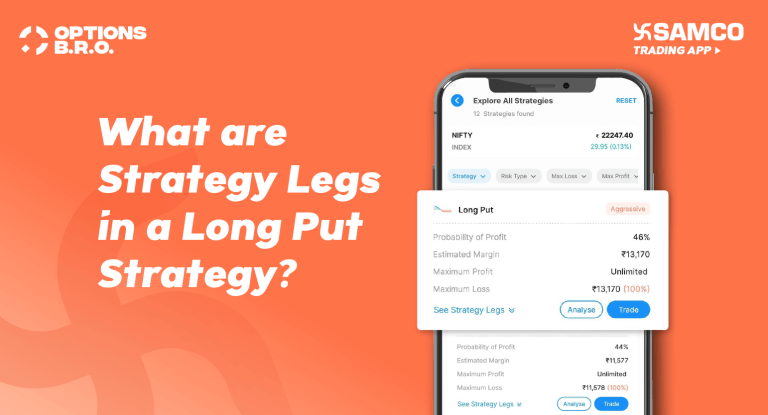
One of the simplest ways to grasp this concept is through the Long Put Strategy — a single-leg bearish position that benefits from falling prices.
Understanding strategy legs is crucial to mastering options — and the Long Put Strategy is one of the simplest places to start.
What Is a Put Option?
A Put Option is a contract that gives the buyer the right (but not the obligation) to sell an underlying asset (like a stock or index) at a predetermined strike price within a specified expiry period.
Key components of a Put Option:
- Strike Price: The price at which you can sell the underlying asset.
- Premium: The cost of buying the option.
- Expiration Date: The day the option contract ceases to exist.
- Underlying Asset: The security on which the option is based (e.g., Nifty 50, Reliance Industries).
Example:
You buy one Nifty 20,000 Put at a premium of ₹100. This means you have the right to sell Nifty at 20,000 before expiry. If Nifty drops to 19,500, your Put increases in value because you can sell higher than the market price — turning a profit.
A Put Option is typically used by traders who expect the market to fall or want to hedge existing long positions against downside risk.
What Is a Long Put Strategy?
The Long Put Strategy is a bearish options strategy where a trader buys a put option expecting the price of the underlying to decline. It is one of the most straightforward single-leg strategies — simple to understand, execute, and manage.
Here’s how it works:
- You pay a premium to buy a Put Option.
- If the price of the stock or index falls below the strike price, the value of your Put rises.
- If the price remains above the strike, the Put expires worthless, and your loss is limited to the premium paid.
Example:
|
Particulars |
Value |
|---|---|
|
Underlying |
Nifty 50 |
|
Strike Price |
₹20,000 |
|
Premium Paid |
₹100 |
|
Expiry |
Monthly |
Scenarios:
- Nifty closes at ₹19,800 → Intrinsic value = ₹200 → Profit = ₹200 – ₹100 = ₹100.
- Nifty closes at ₹20,000 or above → Put expires worthless → Loss = ₹100 (premium).
Payoff Summary:
- Maximum Loss: Limited to the premium paid (₹100).
- Maximum Profit: Strike Price – Premium (if Nifty falls to zero theoretically).
- Breakeven: Strike Price – Premium = ₹19,900.
The Long Put offers traders a low-cost bearish exposure with defined risk — a key advantage for both beginners and professionals.
Understanding Strategy Legs in a Long Put
In options terminology, a leg refers to an individual component or position within an options strategy. For example, a Bull Call Spread has two legs (one buy and one sell call), while a Long Straddle has two legs (buy call + buy put).
In contrast, the Long Put Strategy has only one leg — the buy put position.
This single leg defines the entire strategy’s risk, reward, and behaviour. However, even with one leg, a trader must define:
- The strike price (level of bearish expectation).
- The expiration (time horizon).
- The premium (cost of trade).
While multi-leg strategies combine positions to modify payoffs, a single-leg strategy like the Long Put is direct and ideal for learning the foundation of strategy legs.
Comparison Snapshot:
|
Strategy |
No. of Legs |
Example |
Complexity |
|---|---|---|---|
|
Long Put |
1 |
Buy 1 Put |
Simple |
|
Bull Call Spread |
2 |
Buy 1 Call, Sell 1 Call |
Moderate |
|
Iron Condor |
4 |
2 Calls + 2 Puts |
Advanced |
When Should You Use a Long Put Strategy?
The Long Put Strategy works best under specific market conditions:
|
Market Scenario |
Long Put Benefit |
|---|---|
|
Bearish trend |
Profits from falling prices |
|
Rising volatility |
Increases the option premium |
|
Weak fundamentals |
Suitable for bearish speculation |
|
Portfolio hedge |
Protects existing long holdings |
Ideal situations:
- You expect a short-term decline in a stock or index.
- You want to hedge against potential losses in your portfolio.
- You anticipate higher implied volatility (IV) — which can increase option value.
This makes the Long Put a popular choice for both speculation and protection.
Payoff of a Long Put Strategy
The payoff of a Long Put depends on how far the market falls below the strike price.
Formula:
Payoff = Max (Strike Price – Spot Price, 0) – Premium Paid
Example:
You buy a Nifty 20,000 Put @ ₹100.
- If Nifty closes at ₹19,700, Payoff = (20,000 – 19,700) – 100 = ₹200 profit.
- If Nifty closes at ₹20,100, Payoff = 0 – 100 = ₹100 loss (premium).
Breakeven Point = Strike Price – Premium = ₹19,900.
Payoff Table:
|
Nifty Spot at Expiry |
Intrinsic Value |
Net Profit/Loss |
|---|---|---|
|
20,300 |
0 |
–₹100 |
|
20,000 |
0 |
–₹100 |
|
19,900 |
100 |
Breakeven |
|
19,700 |
300 |
+₹200 |
|
19,000 |
1,000 |
+₹900 |
Visual Summary:
- Above 19,900: Limited loss (premium).
- Below 19,900: Profit increases as the index falls further.
This asymmetrical payoff (limited loss, unlimited gain till zero) is what makes the Long Put an attractive risk-defined trade.
Role of Implied Volatility (IV) in a Long Put
Implied Volatility (IV) measures the market’s expectation of future price movement. It plays a crucial role in determining option premiums.
For a Long Put Strategy:
- Higher IV increases the option’s premium (benefits traders who already hold puts).
- Lower IV decreases premium value (unfavourable for put buyers).
Example:
If Nifty IV rises from 10% to 20% after you buy a Put, the option’s price can increase even if the index hasn’t moved significantly.
Tip:
Enter long put positions when volatility is expected to rise, such as before major events, earnings, or policy announcements. This boosts potential gains from both price movement and volatility expansion.
Practical Example: Long Put Strategy on a Stock
Let’s take a realistic scenario using Infosys as the underlying.
|
Parameter |
Value |
|---|---|
|
Underlying Stock |
Infosys |
|
Current Price |
₹1,600 |
|
Put Strike |
₹1,580 |
|
Premium Paid |
₹25 |
|
Expiry |
1 Month |
Outcome Scenarios:
- Stock falls to ₹1,520:
Profit = (1,580 – 1,520) – 25 = ₹35 per share. - Stock remains at ₹1,600:
Option expires worthless → Loss = ₹25 (premium). - Stock rises to ₹1,650:
No intrinsic value → Loss = ₹25 (premium).
Interpretation:
- Breakeven: ₹1,555.
- Max Loss: ₹25.
- Max Profit: ₹1,580 – ₹25 = ₹1,555 (if stock goes to zero).
This structure illustrates how a single strategy leg (buying a Put) can serve both speculative and protective purposes.
Pros and Cons of a Long Put Strategy
Advantages:
- Limited risk: Loss capped at the premium paid.
- Simple setup: Only one leg, easy to manage.
- High profit potential: Gains rise as the stock declines.
- Effective hedge: Protects against portfolio drawdowns.
Disadvantages:
- Time decay (Theta): Option value erodes as expiry nears.
- Requires timing: Profits depend on quick price declines.
- Flat market risk: No movement results in full premium loss. Common Mistakes to Avoid
- Buying far OTM (Out-of-the-Money) puts: Cheap, but often expire worthless.
- Ignoring volatility: Entering during low IV reduces potential benefit.
- Forgetting breakeven calculation: Knowing where profit starts is critical.
- Holding till expiry without monitoring: Time decay accelerates near expiry — exit or roll early if the market doesn’t move.
Pro Tip: Track your Long Put using payoff calculators or margin tools to visualise risk and reward dynamically.
Conclusion
A strategy leg is simply one position within an options strategy, and in a Long Put Strategy, there’s only one leg — the long put itself. Despite its simplicity, it’s a powerful bearish setup that allows traders to profit from declining prices while keeping risk limited to the premium paid.
By understanding how strike selection, implied volatility, and payoff interact, traders can use the Long Put Strategy effectively for both hedging positions and short-term bearish speculation.